
The psychology behind organizational innovation explains how human behavior, motivation, emotions, and social dynamics shape innovation in workplaces. It matters today because innovation depends more on mindset and culture than technology alone. Future organizations will rely increasingly on psychological safety, learning behavior, and emotionally intelligent leadership to sustain innovation.
The Psychology Behind Organizational Innovation
Organizations talk about innovation as if it’s a tool you can install or a system you can buy. That’s never been true. Innovation starts in the mind. It lives in how people think, feel, take risks, and respond to uncertainty.
Here’s what matters. Organizations do not innovate. People do. And people bring emotions, habits, fears, motivation, identity, and social pressure into every creative effort. When innovation fails, it is rarely because of a lack of ideas. It fails because the psychological conditions were wrong.
Psychology of Organizational Innovation
| Aspect | Explanation |
|---|---|
| Definition | Study of how human thoughts, emotions, and behaviors influence innovation |
| Core focus | Motivation, creativity, risk-taking, learning, and trust |
| Key drivers | Psychological safety, autonomy, curiosity, leadership behavior |
| Main theories | Drucker’s purposeful innovation, Schumpeter’s creative destruction |
| Real-world use | Improving workplace creativity, culture change, leadership decisions |
| Advantages | Sustainable innovation, higher engagement, better idea flow |
| Current status | Central to modern organizational psychology and leadership research |
| Future direction | Greater focus on emotional intelligence and adaptive cultures |
This article explains innovation from a human angle. No corporate noise. No empty frameworks. Just psychology, behavior, and real workplace dynamics.
What Is the Psychology of Innovation?
The psychology of innovation looks at how and why people generate new ideas, support them, resist them, or shut them down. It focuses on mental processes, not business buzzwords.
Innovation depends on a few core psychological forces:
- Curiosity over compliance
- Motivation over pressure
- Safety over fear
- Learning over perfection
When these forces are present, ideas grow. When they’re missing, even brilliant ideas die quietly.
From a psychological view, innovation is not about being creative once. It’s about sustaining creative behavior over time, especially when outcomes are uncertain.
People innovate when they feel:
- Safe enough to speak
- Valued enough to try
- Trusted enough to fail
- Motivated enough to persist
That’s the foundation.
Motivation and Creative Thinking
Motivation is the engine of innovation. Not bonuses. Not slogans. Internal motivation.
People are more innovative when they:
- Feel ownership over their work
- See meaning in what they do
- Have autonomy in how they solve problems
External rewards can help short-term output, but they often reduce creative risk-taking. When people feel controlled, they play safe. Innovation needs the opposite.
Fear, Failure, and Risk Perception
Fear is the silent killer of innovation.
Fear of embarrassment
Fear of being wrong
Fear of punishment
Fear of looking foolish
In many organizations, failure is tolerated in words but punished in behavior. People notice. They adapt. They stop sharing ideas.
Psychologically safe environments don’t remove failure. They remove shame. When mistakes are treated as data instead of personal flaws, learning accelerates.
The Four Types of Organizational Innovation
Innovation doesn’t look the same everywhere. Psychologically, each type demands different mental shifts.
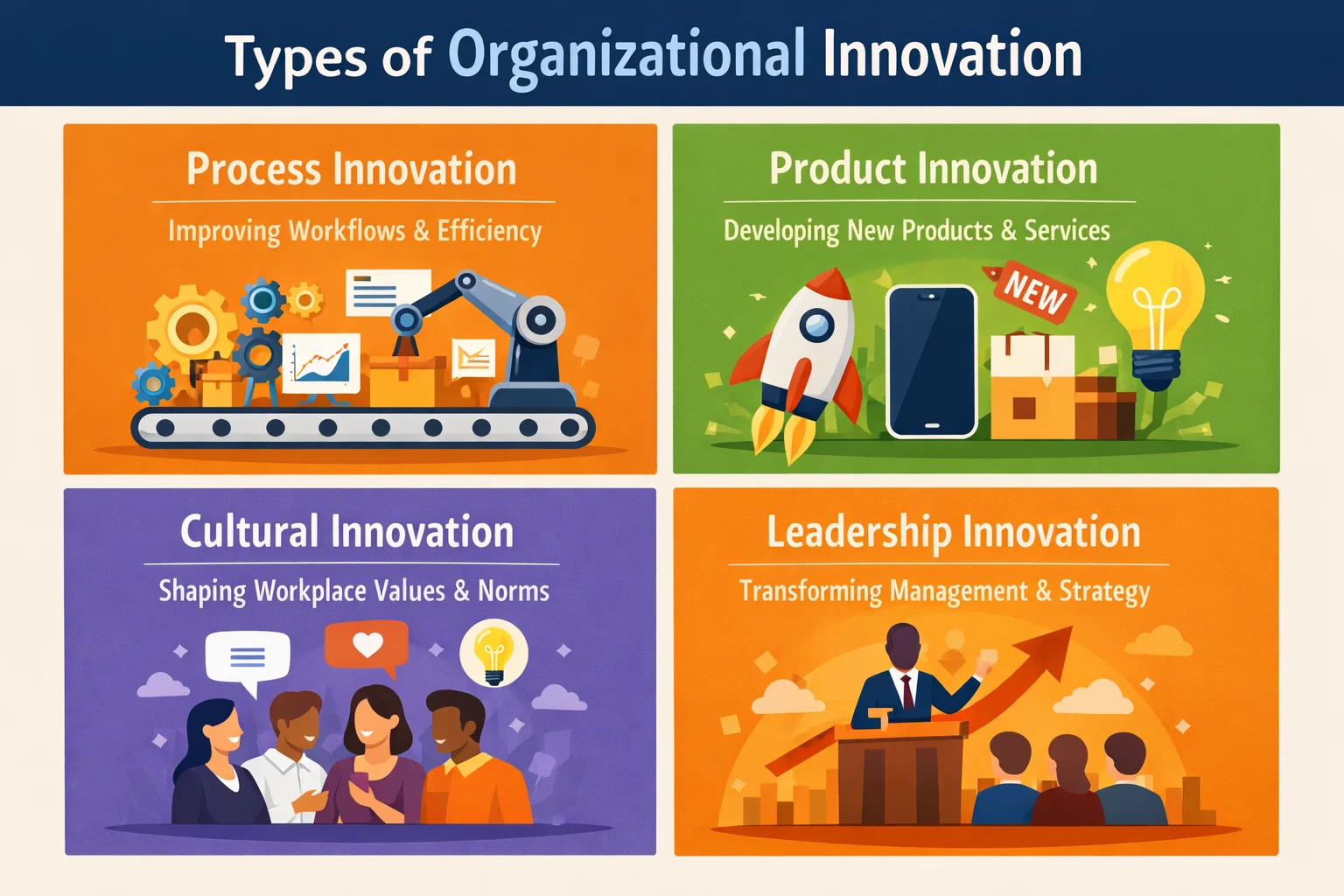
Product Innovation
Product innovation relies on empathy and perspective-taking. People must imagine needs they don’t personally experience. That requires cognitive flexibility and curiosity.
Teams that innovate products well:
- Listen more than they assume
- Test ideas early
- Accept feedback without defensiveness
Process Innovation
Process innovation challenges habits. Habits feel comfortable. Changing them creates resistance.
Psychologically, process innovation triggers:
- Loss of control
- Fear of inefficiency
- Threat to competence
Successful process innovation respects these emotions instead of ignoring them.
Organizational and Cultural Innovation
This is the hardest type. Culture is emotional memory. It’s built from repeated experiences of what is rewarded, ignored, or punished.
Changing culture means changing:
- Beliefs about power
- Norms around voice
- Unspoken rules of safety
You can’t force this. You model it.
Leadership and Strategic Innovation
Strategic innovation requires leaders to tolerate ambiguity. That’s psychologically demanding.
Leaders who innovate strategically:
- Resist the urge for certainty
- Delay judgment
- Hold multiple possibilities at once
This is emotional discipline, not intelligence.
Peter Drucker’s Psychological View of Innovation and MBO
Peter Drucker viewed innovation as purposeful behavior, not accidental genius.
His idea was simple. Innovation works when people understand:
- What they are trying to achieve
- Why it matters
- How their role contributes
That’s where Management by Objectives comes in.
Innovation as Discipline
Creativity does not mean chaos. Psychological freedom works best inside clear boundaries.
Clear goals reduce anxiety. They focus attention. They help people channel creativity instead of scattering it.
Psychological Impact of MBO
When done right, MBO:
- Builds autonomy
- Clarifies responsibility
- Reduces role confusion
When done wrong, it becomes control disguised as structure. The difference is psychological trust.
One of Drucker’s most cited lines captures this mindset clearly:
“The best way to predict the future is to create it.”
That statement is about agency, not forecasting.
Joseph Schumpeter and the Psychology of Creative Destruction
Schumpeter’s theory explains why innovation feels threatening.
Creative destruction means new ideas don’t just add value. They replace identities. Jobs change. Skills become outdated. Status shifts.
Psychologically, this creates grief.
People resist innovation not because they hate progress, but because progress often means:
- Losing mastery
- Losing relevance
- Losing certainty
Organizations that ignore this emotional cost face passive resistance. Those that acknowledge it gain trust.
Change, Loss, and Adaptation
Innovation requires emotional processing. People need time to let go of what worked before they can accept what comes next.
Change without empathy breeds compliance, not commitment.
The Core Frameworks of Innovation Explained Psychologically
Frameworks are only useful when they guide thinking, not replace it.
The 4 Cs of Innovation
Creativity
Collaboration
Curiosity
Commitment
Psychologically, these reflect:
- Openness
- Social trust
- Intrinsic motivation
- Persistence
Remove one, and innovation weakens.
The 4 Ps of Innovation
Product
Process
Position
Paradigm
Paradigm is the psychological core. It’s about how people interpret reality. Real innovation often starts with seeing the same problem differently.
The 4 Rs of Innovation
Research
Reframe
Realize
Repeat
This mirrors learning psychology. Innovation improves through feedback loops, not single breakthroughs.
The 5 Cs and 7 Cs of Creativity
These models expand on social and cognitive flexibility. Their shared message is clear. Innovation thrives in environments that value thinking, not just results.
Is Coca-Cola an Innovation? A Psychological Perspective
Coca-Cola is not innovative because of constant reinvention. It’s innovative because of emotional consistency.
Psychologically, it understands:
- Habit formation
- Nostalgia
- Emotional branding
- Cultural adaptation
Innovation doesn’t always mean radical change. Sometimes it means protecting emotional meaning while evolving delivery.
That’s behavioral intelligence.
Leadership Psychology and Innovation
Leaders don’t create innovation by demanding it. They create it by shaping emotional climate.
Innovative leaders:
- Ask more than they tell
- Listen without defending
- Respond calmly to failure
- Reward learning publicly
Psychological Safety and Trust
People speak up when silence feels riskier than honesty.
Trust grows when leaders:
- Admit uncertainty
- Share credit
- Take responsibility for failure
Emotional Intelligence in Leaders
Emotionally intelligent leaders notice:
- Who is quiet
- Who is anxious
- Who is disengaged
They respond with curiosity, not authority.
Innovation and the Core Ideas of Psychology
Innovation touches every major psychological domain:
- Cognition: flexible thinking and problem-solving
- Emotion: fear, excitement, frustration, hope
- Learning: feedback, experimentation, adaptation
- Social psychology: influence, norms, power, belonging
Innovation is not a management skill. It’s a human behavior pattern shaped by environment.
Bottom Line
Innovation succeeds when organizations understand people before processes.
You don’t force creativity.
You create conditions where it feels safe, meaningful, and worth the risk.
That’s the psychology behind organizational innovation.
Frequently Asked Questions:
What is the psychology of innovation?
The psychology of innovation studies how people think, feel, and behave when creating new ideas. It focuses on motivation, curiosity, fear of failure, learning habits, and social influence. Innovation happens when people feel safe, valued, and mentally free to experiment.
What are the four types of organizational innovation?
The four types are product innovation, process innovation, organizational or cultural innovation, and leadership or strategic innovation. Each type depends on different psychological factors such as empathy, habit change, trust, and tolerance for uncertainty.
What is Peter Drucker’s theory of innovation?
Peter Drucker viewed innovation as purposeful and systematic work, not random creativity. He believed innovation comes from understanding opportunities, setting clear goals, and aligning human effort through meaningful objectives rather than control.
What are the four Cs of innovation?
The four Cs are creativity, collaboration, curiosity, and commitment. Psychologically, they reflect open thinking, social trust, intrinsic motivation, and persistence in the face of uncertainty.
What are the four pillars of innovation?
The four pillars usually refer to people, processes, culture, and leadership. From a psychology perspective, people and culture matter most because beliefs, emotions, and social norms shape how innovation actually happens.
What are the four Rs of innovation?
The four Rs are research, reframe, realize, and repeat. They mirror learning psychology, where ideas improve through feedback, reflection, testing, and continuous adaptation.
What is Management by Objectives (MBO) in psychology terms?
MBO works psychologically by giving people clarity, autonomy, and responsibility. When goals are meaningful and not controlling, they increase motivation, focus, and engagement rather than stress.
What is Joseph Schumpeter’s theory of innovation?
Schumpeter described innovation as creative destruction, where new ideas replace old systems. Psychologically, this explains why people resist innovation, because it threatens identity, skills, and emotional security.
Is Coca-Cola an example of innovation?
Yes, but not because of constant product change. Coca-Cola shows psychological innovation through emotional branding, habit formation, and cultural adaptation while maintaining a stable core identity.
What are ten types of innovation?
They include product, process, service, business model, cultural, leadership, marketing, technological, social, and strategic innovation. Each type depends on different patterns of human thinking and behavior.
What are the five Cs of innovation?
The five Cs often include creativity, collaboration, curiosity, courage, and consistency. Together, they describe the psychological balance between idea generation and long-term effort.
What are the seven Cs of creativity?
The seven Cs highlight traits like curiosity, confidence, courage, concentration, commitment, collaboration, and creativity itself. These traits support sustained creative behavior rather than one-time ideas.

Muhammad Nawaz is the founder of Psyvanta.com and writes simple, practical psychology content for South Asian readers. He focuses on real-life problems like stress, motivation, relationships, and daily mental well-being, turning research into clear advice people can actually use.