
Organizational psychology examines how human behavior, leadership, and workplace culture affect safety outcomes. It is important because most workplace accidents stem from psychological factors like stress, fear, and poor communication rather than technical failure. As workplaces evolve, psychology-driven safety systems will play a central role in reducing risk and improving well-being.
The Role of Organizational Psychology in Workplace Safety
Workplace safety is often discussed in terms of rules, equipment, and compliance. Helmets, checklists, alarms, and procedures matter. But they are only part of the picture. Many serious workplace accidents happen even when safety rules exist and equipment is available. That gap is where psychology steps in.
Organizational psychology focuses on how people think, behave, communicate, and make decisions at work. It looks at leadership styles, group behavior, stress, motivation, and workplace culture. When applied to safety, it explains why people ignore rules, stay silent about risks, or take shortcuts even when they know better.
Here’s the key point. Safety failures are often human failures, not technical ones. People get tired, feel pressured, fear blame, or assume someone else will handle the risk. Organizational psychology helps organizations understand these patterns and design systems that work with human behavior instead of fighting against it.
Workplace safety improves when employees feel respected, heard, and supported. When workers trust their leaders and coworkers, they report hazards early. They ask questions. They slow down when something feels wrong. That kind of behavior does not come from rules alone. It comes from a psychologically safe environment.
This article explains how organizational psychology shapes workplace safety from the inside out. It covers psychological safety, safety culture, leadership behavior, and practical steps organizations can take to prevent harm. The goal is simple. Fewer injuries. Healthier people. Safer workplaces that actually function under real pressure.
Why Organizational Psychology Is Important in the Workplace
Organizations are human systems. Machines follow instructions exactly. People do not. They interpret, adapt, resist, and sometimes ignore rules based on how they feel and what they experience daily.
Organizational psychology explains these human reactions. It studies motivation, stress, attention, fatigue, learning, and social influence. All of these directly affect safety behavior. A worker under extreme pressure may rush. A tired employee may miss warning signs. A junior staff member may notice a hazard but stay quiet out of fear.
Safety programs fail when they assume people will always behave logically. In reality, behavior is shaped by deadlines, leadership tone, peer pressure, and job insecurity. Organizational psychology helps leaders see these invisible forces.
Another reason this field matters is prevention. Many accidents are predictable. They follow patterns of stress, poor communication, unclear roles, and weak leadership. Psychology helps identify these patterns early, before injuries occur.
It also supports long-term safety. Fear-based enforcement may create short-term compliance, but it damages trust. Over time, people hide mistakes instead of reporting them. Organizational psychology promotes learning-based safety, where errors are treated as signals for improvement rather than punishment.
Organizational Psychology and Workplace Safety
| Aspect | Explanation |
|---|---|
| Definition | Study of human behavior and mental processes at work |
| Core purpose | Improve safety, performance, and employee well-being |
| Key focus areas | Leadership, stress, communication, safety culture |
| Role in safety | Reduces accidents by addressing human error and fear |
| Psychological safety | Employees feel safe to speak up and report risks |
| Real-world use | Hazard reporting, leadership training, safety design |
| Main benefits | Fewer injuries, better teamwork, early risk detection |
| Current relevance | Essential for modern, high-pressure work environments |
| Future direction | More behavior-based and mental health–focused safety systems |
In short, organizational psychology shifts safety from control to understanding. It helps organizations design environments where safe behavior is the easiest and most natural option.
The Psychology of Safety in the Workplace
Safety is not only physical. It is psychological. How safe people feel mentally influences how they act physically.
The psychology of safety looks at how workers perceive risk. Two people can face the same hazard and react differently. One may stop work immediately. The other may continue, assuming nothing will happen. These reactions depend on experience, training, stress levels, and workplace norms.
Attention is another critical factor. High workload and constant interruptions reduce focus. When attention drops, mistakes increase. This is why accidents often happen near shift changes, during overtime, or under tight deadlines.
Emotions also play a role. Fear, anger, frustration, and anxiety narrow attention and reduce judgment. An employee worried about losing their job may take risks to appear fast or efficient. Someone who feels disrespected may disengage and stop caring about procedures.
Safety psychology also examines habits. Many unsafe acts are not deliberate. They are automatic behaviors learned over time. If shortcuts are rewarded with praise or speed, they become routine. Changing these habits requires more than reminders. It requires changing what the organization values and reinforces.
Understanding these psychological processes helps organizations design safer workflows, realistic schedules, and supportive leadership practices that reduce risk at its source.
Psychological Factors That Shape Workplace Safety Practices
Several psychological factors strongly influence safety behavior at work.
Perceived pressure is one. When employees feel constant time or performance pressure, safety becomes secondary. Even strong safety training can collapse under unrealistic demands.
Trust in leadership is another. If workers believe management truly cares about their well-being, they are more likely to follow safety rules and speak up. If they believe safety is only about avoiding fines or blame, engagement drops.
Fear of consequences also shapes behavior. In workplaces where mistakes lead to punishment, employees hide errors and near-misses. This creates a false sense of safety while risks grow silently.
Group norms matter as well. People adjust their behavior to fit in. If coworkers ignore safety gear or joke about risks, new employees copy that behavior quickly.
Finally, sense of control plays a role. When workers feel they have no say in how work is done, they disengage. When they feel involved in safety decisions, ownership increases.
Organizational psychology helps leaders recognize these factors and adjust systems, communication, and leadership styles to support safer choices.
The Four Stages of Psychological Safety at Work
Psychological safety develops in stages. Each stage supports safer behavior in different ways.
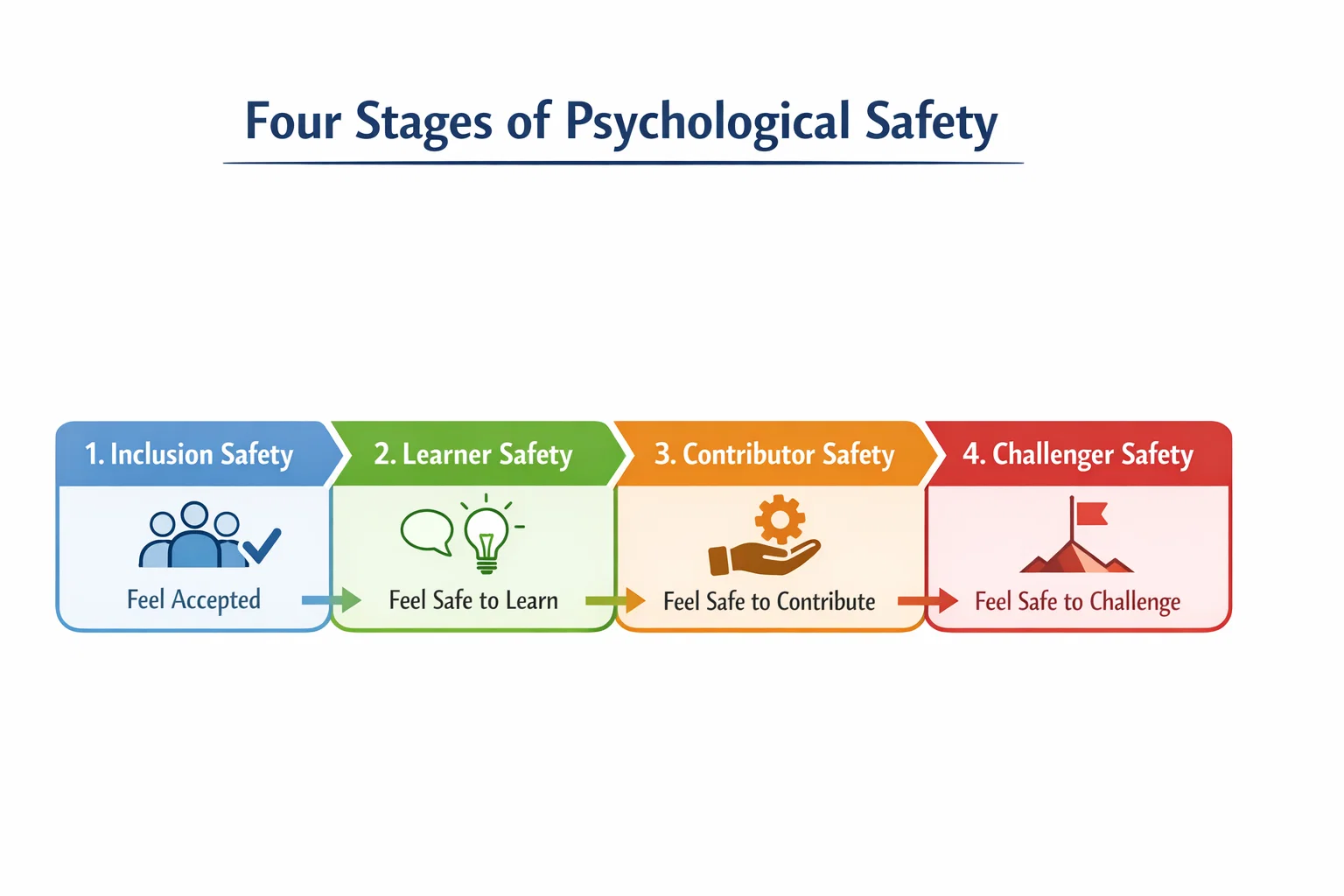
Inclusion safety comes first. Employees feel accepted regardless of role, background, or experience. Without inclusion, people stay silent and withdrawn.
Learner safety follows. Workers feel safe asking questions and admitting they do not know something. This reduces errors caused by misunderstanding or lack of training.
Contributor safety allows employees to share ideas and take responsibility. People actively participate in improving safety processes rather than just following orders.
Challenger safety is the highest stage. Employees feel safe questioning decisions, stopping work, and pointing out risks even when it is uncomfortable.
Workplaces lacking these stages often have warning signs that go unspoken. Psychological safety allows those warnings to surface early.
The 5 C’s of Psychological Safety
Psychological safety is built through consistent behavior, not slogans. The 5 C’s explain what makes it real.
Care means leaders show genuine concern for employee well-being, not just results.
Clarity ensures expectations, roles, and safety procedures are clear and realistic.
Consistency builds trust. Safety rules apply to everyone, including leaders.
Communication stays open and respectful, especially when problems arise.
Confidence grows when employees see that speaking up leads to action, not punishment.
Together, these elements create an environment where safety conversations happen naturally.
The 4 C’s of Safety Culture
Safety culture reflects how safety is treated day to day, not what is written in manuals.
Commitment shows that safety is a priority at all levels.
Compliance ensures rules are followed, but not blindly.
Competence means employees are properly trained and supported.
Communication keeps information flowing about risks, changes, and lessons learned.
Organizational psychology connects these elements by explaining how culture shapes behavior more powerfully than rules alone.
Benefits of Psychological Safety in the Workplace
Psychological safety produces clear benefits.
Accidents and near-misses are reported earlier. Learning improves because mistakes are analyzed instead of hidden. Stress levels decrease, which improves focus and decision-making. Teamwork strengthens, reducing coordination errors.
There is also a performance benefit. Safer workplaces often see higher productivity and lower turnover. When people feel safe, they invest more energy in their work.
Most importantly, psychological safety protects lives. It creates conditions where people look out for each other, not just themselves.
Key Indicators of Psychological Safety at Work
Psychological safety can be observed through behavior.
Employees speak openly in meetings. Mistakes are discussed without blame. Questions are welcomed. Leaders listen and respond calmly.
Another indicator is how near-misses are handled. In psychologically safe workplaces, near-misses are treated as valuable information, not embarrassment.
Respect is the final indicator. Disrespect signals danger. Where respect is strong, safety usually follows.
Five Steps to Building Psychological Safety
Organizations can build psychological safety deliberately.
First, leaders must model openness. Admitting mistakes sets the tone.
Second, encourage speaking up and respond with curiosity, not anger.
Third, separate learning from punishment. Accountability still exists, but it is fair and focused on improvement.
Fourth, train leaders in emotional awareness and communication.
Fifth, reinforce safe behavior through recognition and action.
These steps turn safety into a shared responsibility.
Real Examples of Psychological Safety in the Workplace
A technician stops a production line because something feels wrong. Instead of criticism, the team investigates and prevents a failure.
A junior nurse questions a medication dosage. The team double-checks and avoids harm.
A construction worker reports a near-miss. Procedures are adjusted before an injury occurs.
These examples show psychology at work. Safety happens because people feel safe to act.
The Five Principles of Safety Through a Psychological Lens
Safety principles often include planning, training, supervision, communication, and continuous improvement. Psychology explains why each works only when trust and clarity exist.
Rules without trust fail. Training without support fades. Supervision without respect breeds resistance.
When psychological factors align with safety principles, systems become resilient.
The Role of Psychology in the Workplace
Psychology supports far more than safety. It shapes motivation, leadership, teamwork, and mental health. Safety improves naturally when these areas are healthy.
Organizational psychology helps workplaces design systems that respect human limits and strengths. It turns safety into a daily habit rather than an occasional reminder.
The Five Areas of Occupational Psychology
Occupational psychology includes organizational, clinical, educational, human factors, and health psychology. Each contributes to safety by addressing behavior, mental health, learning, system design, and well-being.
Together, they create a complete view of risk and prevention.
The Four Core Roles of Psychology in Work Settings
Psychology prevents harm by identifying risks early. It changes behavior through understanding, not force. It develops leaders who support safety. And it helps design systems that fit human reality.
Workplace safety improves when psychology is integrated, not added as an afterthought.
FAQs:
Why is organizational psychology important in the workplace?
Organizational psychology helps organizations understand how people think, behave, and respond under pressure. It improves safety, performance, and well-being by addressing stress, motivation, leadership behavior, and communication rather than relying only on rules and equipment.
What is the psychology of safety in the workplace?
The psychology of safety focuses on how mental factors like attention, fatigue, fear, and trust influence safe or unsafe behavior. It explains why people take risks, ignore warnings, or hesitate to report hazards even when safety systems exist.
What role do psychological factors play in workplace safety practices?
Psychological factors shape how employees perceive risk, follow procedures, and speak up about dangers. Stress, workload, fear of blame, and group norms often determine whether safety rules are followed or bypassed.
What are the four stages of psychological safety at work?
The four stages are inclusion safety, learner safety, contributor safety, and challenger safety. Together, they allow employees to belong, ask questions, contribute ideas, and challenge unsafe decisions without fear.
What are the 5 C’s of psychological safety?
The 5 C’s are Care, Clarity, Consistency, Communication, and Confidence. These elements help create an environment where employees feel respected and safe to raise concerns.
What are the 4 C’s of safety culture?
The 4 C’s of safety culture are Commitment, Compliance, Competence, and Communication. They reflect how seriously safety is taken in daily actions, not just written policies.
What are the benefits of psychological safety in the workplace?
Psychological safety leads to fewer accidents, better reporting of near-misses, stronger teamwork, lower stress, and higher productivity. Employees are more engaged and proactive about safety.
What are the three key indicators of psychological safety at work?
Open communication, error reporting without fear, and mutual respect are the three strongest indicators. When these are present, safety risks are identified early.
What are the five steps to psychological safety?
The five steps include modeling openness, encouraging speaking up, responding calmly to mistakes, training leaders in emotional awareness, and reinforcing learning instead of blame.
What is an example of psychological safety at work?
An example is when an employee stops work due to a safety concern and is supported by management instead of criticized. The issue is reviewed and fixed rather than ignored.
What are the five principles of safety?
Common safety principles include planning, training, supervision, communication, and continuous improvement. Psychology explains how these principles work best when trust and clarity exist.
What are the six questions in psychological safety?
They usually focus on whether employees feel safe to speak up, ask questions, admit mistakes, challenge decisions, learn from errors, and be themselves at work.
What are the five areas of occupational psychology?
The five areas include organizational psychology, clinical psychology, educational psychology, human factors psychology, and health psychology. Each contributes to safer workplaces in different ways.
What is the role of psychology in the workplace?
Psychology helps improve safety, leadership, teamwork, motivation, and mental health. It supports systems that match real human behavior instead of assuming perfect compliance.
What are the four roles of psychology at work?
Psychology plays four key roles: preventing harm, changing behavior, developing effective leadership, and designing systems that reduce human error and stress

Muhammad Nawaz is the founder of Psyvanta.com and writes simple, practical psychology content for South Asian readers. He focuses on real-life problems like stress, motivation, relationships, and daily mental well-being, turning research into clear advice people can actually use.