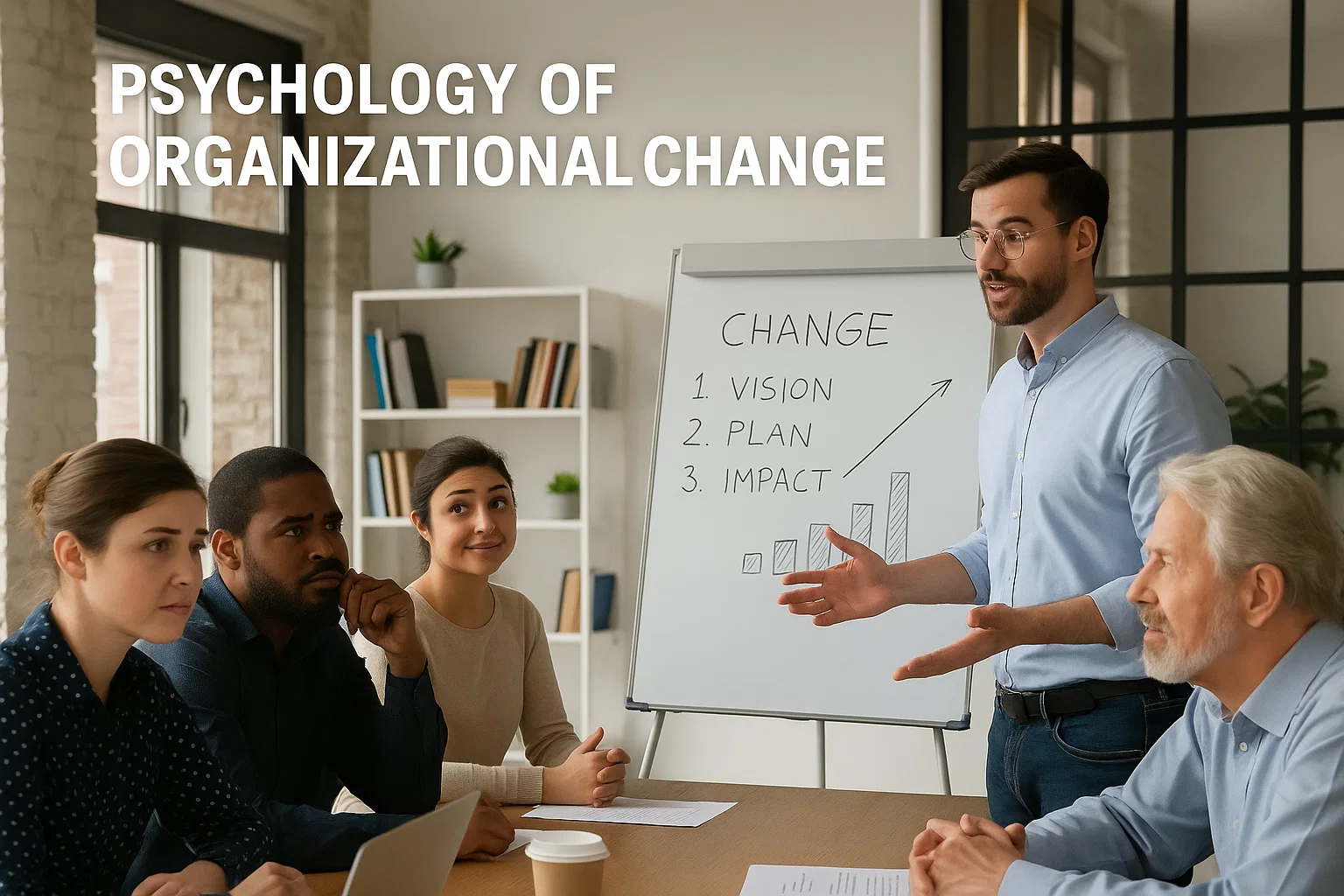
 Change is no longer an occasional event in organizations it’s a constant rhythm. Yet, even in 2026, one hard truth remains: most organizational transformations still fail. According to McKinsey & Company’s 2026 Global Change Report, only 36% of large-scale change efforts fully meet their intended goals. The top reason for failure? Human resistance, not technical hurdles.
Whether it’s Google restructuring teams, Unilever redefining sustainability goals, or startups shifting toward hybrid work, success depends on how people think, feel, and adapt. That’s where psychology steps in not as theory, but as the real driver behind lasting transformation.
This article explores how psychological strategies guide organizations through complex transitions, the emotional and cognitive challenges people face, and how leaders can turn resistance into resilience.
Understanding Organizational Change from a Psychological Lens
At its core, organizational change means altering how people work together their beliefs, routines, and sense of security. It’s not just about shifting processes or job titles; it’s about human adaptation.
Psychologist Kurt Lewin’s Change Model (Unfreeze–Change–Refreeze) still stands as a foundation for understanding this process. The “unfreezing” stage challenges the comfort zone, creating awareness that change is necessary. The “change” stage introduces new behaviors, systems, or roles. Finally, “refreezing” solidifies new norms so they become part of the organization’s culture.
But in 2026, with rapid technological disruption, remote work, and AI integration, this model often cycles continuously rather than linearly. Organizations are in a state of constant “unfreezing.”
Take Google, for instance. Its continuous adaptation to AI-powered products and decentralized teams demonstrates psychological agility. Instead of enforcing rigid control, Google uses open communication, emotional safety, and peer recognition to sustain engagement. Employees are trained not just to accept change but to expect it.
From a psychological perspective, such adaptability relies on trust, communication, and perceived fairness. When employees feel their voices matter, their minds stay open.
Common Psychological Challenges During Change
Change activates the same stress pathways that trigger fear and anxiety. The brain prefers predictability; uncertainty feels like a threat. According to Harvard Business Review (2025), 68% of employees experience stress symptoms during organizational transitions, such as disrupted sleep, irritability, or lack of motivation.
The most common psychological barriers include:
- Fear of Loss Whether it’s losing a role, influence, or identity, employees may cling to what feels familiar.
- Uncertainty Ambiguity about “what happens next” generates anxiety.
- Disrupted Identity When structures shift, people question their value and belonging.
- Social Pressure Groups often resist collectively to maintain harmony or protect their shared norms.
- Cognitive Dissonance Employees struggle when their beliefs (“we’ve always done it this way”) clash with new directives.
In 2024, Microsoft launched a massive AI-integration initiative. The project was technically flawless, but early surveys revealed employee resistance due to “AI anxiety” fears of being replaced. Instead of ignoring emotions, leadership responded by offering workshops on emotional resilience and growth mindset. Within six months, productivity scores improved by 19%, showing that addressing emotions directly accelerates change success.
Bottom line: Change succeeds when psychological safety precedes process.
The 5 C’s of Organizational Change
Psychology-based management experts often use the “5 C’s” framework to guide leaders through transformation: Clarity, Communication, Collaboration, Commitment, and Confidence.
- Clarity – Ambiguity fuels anxiety. Clearly define why change is happening, how it will occur, and what success looks like.
- Example: Unilever’s 2025 “Future of Work” plan began with transparent discussions and employee input sessions across 100+ offices. The company reported 88% higher employee confidence after clarity sessions.
- Communication – Change fails when leaders underestimate the emotional impact of silence. Communication should be open, honest, and two-way.
- Psychological note: Consistent communication reduces uncertainty and strengthens cognitive control.
- Collaboration – When employees feel part of the solution, resistance weakens. Involving teams in redesigning workflows promotes ownership.
- Commitment – Leaders must model change behavior themselves. Commitment is contagious people follow consistency.
- Confidence – Small wins reinforce belief. Celebrate visible progress to build collective self-efficacy, a key term from Bandura’s social learning theory.
These five pillars combine emotional safety with cognitive clarity essential for sustainable adaptation.
The Role of Leadership and Emotional Intelligence
In organizational psychology, leadership during change is more emotional than procedural. A 2026 Deloitte Insights survey found that companies led by emotionally intelligent managers were 2.4 times more likely to complete transformation successfully.
Emotional intelligence (EI) the ability to recognize, understand, and manage emotions plays three critical roles:
- Empathy: Understanding employee fears helps leaders design supportive strategies.
- Self-regulation: Managing personal stress prevents reactive decisions.
- Social awareness: Recognizing group morale guides communication tone and timing.
Case Study: Satya Nadella at Microsoft
When Nadella took over as CEO, he redefined Microsoft’s culture around a “growth mindset,” replacing fear of failure with curiosity. This shift, rooted in psychologist Carol Dweck’s theory, transformed Microsoft into a learning organization. By 2025, Microsoft’s employee engagement index rose by 37%, proving empathy-based leadership is not “soft” it’s strategic.
Psychological takeaway: Leaders who model vulnerability and trust turn resistance into participation.
Managing the Seven Major Challenges of Change
Change management often hits seven psychological and organizational roadblocks. Here’s how research and real examples suggest overcoming them:
| Challenge | Psychological Impact | Effective Strategy |
|---|---|---|
| Lack of Clarity | Anxiety, confusion | Use visual roadmaps and open forums (e.g., Google’s “Town Halls”) |
| Fear of the Unknown | Stress, avoidance | Offer training and transparency |
| Low Trust | Resistance, gossip | Build credibility through consistent leadership |
| Poor Communication | Misinformation | Regular emotional check-ins and feedback loops |
| Misaligned Values | Disengagement | Reconnect goals with company purpose |
| Burnout | Exhaustion, withdrawal | Encourage rest, flexible work models |
| Cultural Resistance | Group opposition | Use “change champions” within each team |
Each challenge reflects a psychological mismatch between expectation and reality. The most successful organizations treat these as emotional barriers, not disciplinary issues.
For example, Unilever identified “change fatigue” among middle managers in 2025. They launched “Project Thrive,” combining mindfulness sessions and resilience training. Within a year, absenteeism dropped by 22%, and satisfaction scores climbed significantly proving that mental energy management is a business strategy.
Psychological Strategies for a Successful Transition
Psychological tools help employees reshape their internal narrative about change. Here are evidence-backed methods that organizations use in 2026:
- Mindset Reframing: Encourage employees to view change as an opportunity, not a threat. Cognitive reframing reduces cortisol levels and improves problem-solving.
- Resilience Training: Programs teaching coping mechanisms breathing techniques, journaling, peer support strengthen psychological flexibility.
- Empathy Mapping: Used at Spotify and Adobe, this helps leaders identify emotional pain points before rollout.
- Storytelling: Sharing success stories humanizes change and strengthens group cohesion.
- Psychological Contract Renewal: Revisiting employee expectations helps rebuild trust and commitment after major shifts.
Psychologically aware organizations also use Behavioral Economics principles. For instance, nudging small habits like scheduling daily “focus hours” during remote work promotes gradual adaptation without triggering overwhelm.
Building a Culture That Embraces Change
Culture is the silent system that determines whether change sticks. According to Gallup’s 2026 Workplace Culture Study, teams with strong psychological safety are 3 times more adaptable to transformation.
Creating such a culture means embedding learning and reflection into daily work. Google’s “20% time” (allowing employees to spend part of their workweek on personal innovation) fosters intrinsic motivation a core factor in Self-Determination Theory.
Similarly, Unilever’s sustainability transformation didn’t succeed through policy alone but by integrating purpose-driven storytelling across all departments. Employees weren’t told what to change; they were inspired by why it mattered.
Practical steps for organizations:
- Encourage continuous feedback without punishment.
- Train leaders to recognize micro-expressions of stress.
- Promote cross-functional learning communities.
- Reward adaptability, not only performance.
When change becomes routine, fear turns into familiarity.
Overcoming Psychological Barriers in Organizations
Resistance is rarely irrational. It’s often a sign of unaddressed emotion. Leaders must recognize these psychological defense mechanisms:
- Denial: “This won’t really happen.”
- Defensiveness: “The old way worked fine.”
- Projection: “Management doesn’t care about us.”
To counter these, psychologists recommend creating a “psychological transition space” a period between the old and new states where employees can emotionally adjust. Tools like mindfulness circles, emotional journaling, and peer mentoring reduce internal conflict.
A 2025 study by the Chartered Institute of Personnel Development (CIPD) found that companies offering structured emotional support saw a 41% drop in resistance behavior. This highlights that mental readiness, not policy, determines change speed.
The Human Side of Organizational Evolution
Change is not a checklist. It’s a psychological journey that reshapes beliefs, behaviors, and belonging. The most successful organizations in 2026 from tech giants to family-owned businesses treat transformation as a human process supported by empathy.
When people feel seen, heard, and valued, they don’t just comply they contribute.
Organizational change, then, is not about what we remove or redesign, but about how we rebuild trust, clarity, and connection. The future of every organization depends not on technology or structure, but on the psychology of its people.
TL;DR
Organizational change succeeds when it prioritizes the human mind. Psychological strategies like emotional intelligence, resilience training, and open communication help reduce resistance and build trust. Real-world data from Google, Unilever, and Microsoft prove that empathy-driven leadership outperforms top-down management. The takeaway: sustainable change is not a management act it’s a psychological journey that thrives on clarity, confidence, and connection.

Muhammad Nawaz is the founder of Psyvanta.com and writes simple, practical psychology content for South Asian readers. He focuses on real-life problems like stress, motivation, relationships, and daily mental well-being, turning research into clear advice people can actually use.