Psychological assessments in employee selection are standardized tools used to evaluate abilities, personality, and behavior relevant to job performance. They matter because modern hiring demands accuracy, fairness, and predictive decision-making. As workplaces become more complex, these assessments are increasingly integrated with data-driven HR systems to support ethical, evidence-based hiring and long-term employee development.
The Role of Psychological Assessments in Employee Selection
Hiring has changed. Gut feeling is no longer enough. Organizations today face complex roles, diverse teams, and high costs of wrong hiring. One poor selection decision can affect productivity, morale, and even company culture for years. This is where psychological assessments matter.
Psychological assessments bring structure to hiring. They help organizations understand how a person thinks, reacts, solves problems, and fits into a role. Instead of guessing, employers rely on evidence. Instead of bias, they use standardized tools. That shift alone explains why psychological testing is now a core part of employee selection across industries.
Facts About Psychological Assessments in Employee Selection
| Aspect | Explanation |
|---|---|
| Definition | Standardized methods to evaluate psychological traits for hiring |
| Main purpose | Predict job performance and role suitability |
| Common use | Recruitment, promotions, leadership development |
| Test types | Personality, aptitude, intelligence, interest tests |
| Psychometric focus | Reliability, validity, and fairness |
| Advantages | Reduces bias, improves hiring accuracy |
| Limitations | Cannot replace human judgment |
| Current status | Widely used in evidence-based HR practices |
| Future direction | Greater integration with analytics and ethical AI tools |
Here’s what matters. Psychological assessments are not about labeling people as good or bad. They are about fit, prediction, and fairness. When used correctly, they help organizations choose candidates who are more likely to perform well, adapt, and grow.
What Is the Main Purpose of Psychological Assessment?
The main purpose of psychological assessment is simple. It helps understand a person in a structured, scientific way. In employee selection, this means evaluating abilities, personality traits, motivation, and behavior patterns that matter for a specific job.
Psychological assessment answers practical questions. Can this person handle pressure? Do they work well in teams? Are they detail-focused or big-picture thinkers? Will they follow rules or challenge them? Interviews alone cannot answer these reliably.
Assessments also bring consistency. Every candidate is measured using the same criteria. This reduces favoritism and personal bias. It also improves legal and ethical safety for organizations.
At a deeper level, psychological assessment helps match people to roles where they can succeed. That benefits both sides. Employees feel less stressed and more competent. Employers see better performance and lower turnover.
The Four Components of Psychological Assessment
Psychological assessment is not a single test. It is a process with four core components.
First is measurement. This involves using standardized tests or tools to collect data about abilities, personality, or behavior.
Second is evaluation. Raw scores mean nothing on their own. They must be interpreted using norms, job requirements, and psychological principles.
Third is decision-making. Assessment results are used to support hiring or development decisions. They do not replace judgment but guide it.
Fourth is feedback and ethics. Results should be handled responsibly. Confidentiality, fairness, and transparency are essential, especially in workplace settings.
Together, these components ensure that assessments are useful, ethical, and accurate.
The flow of psychological testing stages in recruitment
Where Are Psychological Assessments Used?
Psychological assessments are used far beyond hiring. In the workplace, they appear in recruitment, promotions, leadership development, and training needs analysis.
Outside organizations, assessments are used in clinical psychology, education, forensic settings, and career counseling. The same principles apply everywhere. Measure relevant traits. Interpret them responsibly. Use results to support better decisions.
In employee selection specifically, assessments help answer one key question. Is this person suitable for this role at this time? That focus makes them powerful tools when used correctly.
Most Commonly Used Psychological Assessments in Employee Selection
Not all psychological tests are the same. Different roles require different tools. That’s why organizations use multiple types of assessments.
The Four Types of Psychological Tests
Personality tests assess traits like emotional stability, conscientiousness, openness, and teamwork. They help predict work style and interpersonal behavior.
Aptitude tests measure specific abilities such as numerical reasoning, verbal skills, or mechanical understanding.
Intelligence tests focus on general cognitive ability. These are strong predictors of job performance in many roles.
Interest inventories explore what type of work motivates a person. These are especially useful for long-term career fit.
Each type serves a different purpose. Together, they create a clearer picture of the candidate.
What Is a Psychometric Test in Employee Selection?
A psychometric test is a standardized psychological test designed to measure mental abilities, personality traits, or behavioral tendencies. The key word here is standardized. Every candidate takes the same test under the same conditions.
Psychometric tests rely on statistics and psychology. They are built to be reliable and valid. That means they produce consistent results and actually measure what they claim to measure.
In employee selection, psychometric tests help predict how a person is likely to perform at work. Research consistently shows that well-designed psychometric tests are better predictors of job success than unstructured interviews alone.
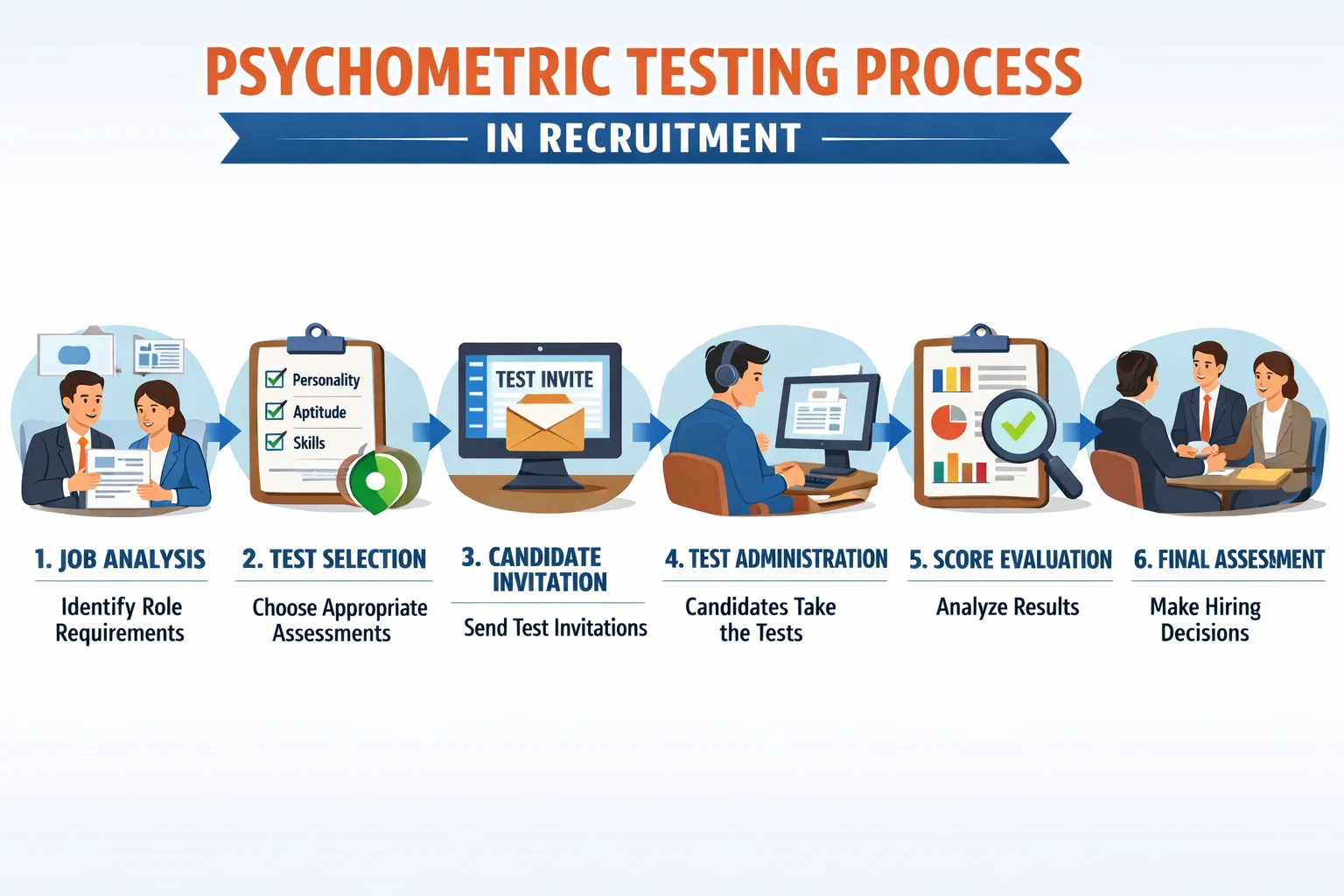
How Psychological Tests Contribute to Recruitment Decisions
Psychological tests do not replace interviews. They support them. Tests provide objective data. Interviews provide context.
When both align, confidence in the hiring decision increases. When they differ, it prompts deeper questioning. This reduces impulsive decisions and overreliance on charm or first impressions.
Psychological tests also support fairness. Every candidate gets the same opportunity to demonstrate ability. This is especially important in large-scale recruitment and competitive roles.
The Five Steps of the Employee Selection Process
Most structured selection systems follow five core steps.
First is job analysis. Organizations define what the role actually requires.
Second is screening. Applications are reviewed to meet basic criteria.
Third is assessment. Psychological tests, interviews, or simulations are used.
Fourth is evaluation. Results are compared against job requirements.
Fifth is selection and placement. The best-fitting candidate is chosen.
Psychological assessments play their strongest role in the third and fourth steps.
The Seven Steps of Psychological Assessment
Psychological assessment follows its own structured process.
It begins with defining the purpose. What decision needs to be made?
Next comes selecting appropriate tools. Not every test fits every role.
Then data is collected under standardized conditions.
Results are scored and interpreted carefully.
Findings are integrated with other information like interviews.
Decisions are made using all available evidence.
Finally, results are documented and handled ethically.
Skipping steps weakens accuracy. Following all seven strengthens trust and usefulness.
The Four P’s and Five P’s of Psychological Assessment
The Four P’s model focuses on person, problem, process, and prediction. It helps psychologists organize assessment information logically.
The Five P’s model adds prognosis. This is especially useful in development-focused roles where growth potential matters.
In employee selection, these models ensure that assessments remain structured, job-related, and forward-looking.
Validity and Reliability in Workplace Psychological Testing
This is where many organizations fail. Tests are easy to buy. Proper use is not.
Validity means the test measures what it claims to measure. A leadership test should predict leadership behavior, not just confidence.
Reliability means results are consistent over time and across situations.
Without validity and reliability, assessment results are meaningless. Worse, they can lead to unfair decisions.
Why Validity Matters in Employee Selection
Predictive validity is especially important. It answers one question. Does this test predict future job performance?
Content validity also matters. Test items must reflect real job tasks.
Construct validity ensures the test truly measures the psychological trait it claims to assess.
Strong validity protects both employees and organizations.
Ethical Risks of Poor Assessments
Poorly designed assessments increase bias. They can discriminate unfairly. They can also expose organizations to legal risk.
Ethical assessment requires trained professionals, appropriate tools, and transparent use of results.
Benefits and Limitations of Psychological Assessments
Psychological assessments offer clear benefits. Better hiring decisions. Reduced turnover. Improved performance. Fairer processes.
But they have limits. Tests cannot capture everything. They should never be the only decision tool. Cultural context, job changes, and individual growth also matter.
The key is balance. Assessments guide decisions. They do not replace human judgment.
Why Psychological Assessments Support Long-Term Employee Development
The role of psychological assessment does not end after hiring. Assessment results help identify training needs, leadership potential, and career paths.
Employees placed in roles aligned with their abilities experience less stress. They learn faster. They perform better. Organizations benefit from stronger engagement and retention.
Bottom line. Psychological assessments are not just selection tools. They are long-term investment tools.
When used ethically and scientifically, they help organizations build healthier, more effective workplaces.
Frequently Asked Questions:
What is the use of psychological tests in the selection process?
Psychological tests help employers evaluate abilities, personality traits, and behavior that interviews often miss. They support fair hiring by providing objective data about how well a candidate fits a job role and work environment.
What is the role of psychological tests in recruitment?
Psychological tests support recruitment by predicting job performance, reducing hiring bias, and improving decision accuracy. They help recruiters compare candidates using standardized criteria instead of personal impressions.
What is a psychometric test in employee selection?
A psychometric test is a standardized assessment used to measure cognitive ability, personality, or work-related behavior. In employee selection, these tests help predict how a candidate is likely to perform in a specific role.
What are the most commonly used psychological assessments?
The most commonly used assessments in employee selection include personality tests, aptitude tests, intelligence tests, and interest inventories. Each test serves a different purpose depending on job requirements.
What are the four types of psychological tests?
The four main types of psychological tests are personality tests, intelligence tests, aptitude tests, and interest tests. Together, they provide a balanced view of a candidate’s abilities and work style.
What are the four purposes of psychology in assessment?
The four purposes are to describe behavior, explain behavior, predict future behavior, and support informed decision-making. In hiring, prediction and explanation are especially important.
What are the four components of psychological assessment?
Psychological assessment includes measurement, interpretation, decision-making, and ethical feedback. All four components ensure results are accurate, useful, and responsibly applied.
What are the 7 steps of psychological assessment?
The seven steps include defining purpose, selecting tools, data collection, scoring, interpretation, integration of results, and ethical reporting. Skipping steps can reduce accuracy and fairness.
What are the 5 steps of the employee selection process?
The five steps are job analysis, screening, assessment, evaluation, and final selection. Psychological assessments play a key role in the assessment and evaluation stages.
What are the four types of selection tests?
Selection tests include cognitive ability tests, personality tests, skill-based tests, and situational judgment tests. Organizations choose based on role demands.
What are the 4 P’s of psychological assessment?
The four P’s are person, problem, process, and prediction. This model helps structure assessment data and link results to workplace decisions.
What are the 5 P’s of psychological assessment?
The five P’s include person, problem, process, prediction, and prognosis. Prognosis focuses on future performance and development potential.
Where are psychological assessments used?
Psychological assessments are used in employee selection, promotions, leadership development, education, clinical practice, and career guidance. Their use depends on decision-making needs.
How do psychological tests contribute to employee development?
Assessment results help identify strengths, skill gaps, and leadership potential. This supports targeted training, better role placement, and long-term career growth.
Why is validity important in psychological testing?
Validity ensures that a test measures what it claims to measure. In hiring, valid tests improve accuracy and reduce the risk of unfair or ineffective decisions.
Can psychological assessments replace interviews?
No. Psychological assessments support interviews but do not replace them. The best hiring decisions combine test data with structured interviews and professional judgment.

M.Phil in Psychology from UET Lahore, Sajid Ali shares clear, research-based insights on mental health, emotions, and social behavior in simple English. Sajid Ali draws on hands-on academic research and real-life observations of emotional and social behavior, turning psychological theory into clear, practical insight for everyday readers.