
The role of psychology in career development and planning explains how interests, personality, motivation, and emotions shape career choices and long-term success. It matters today because careers are no longer linear. Psychological insight helps people adapt, reduce stress, and make informed decisions. Its future impact lies in guiding flexible, well-being-focused career paths.
The Role of Psychology in Career Development and Planning
Career decisions shape how people live, work, and see themselves. Yet many still choose careers based on pressure, trends, or fear of failure. Psychology offers a different lens. It explains why people choose certain paths, why they feel stuck, and how they can build careers that match who they truly are.
Here’s what matters. Career development is not a one-time decision. It is a lifelong psychological process shaped by personality, motivation, emotions, learning, and environment. When people understand these inner forces, career planning becomes clearer, calmer, and more effective.
Psychology helps answer questions people quietly struggle with.
Why do I feel unmotivated at work?
Why did I lose interest in a career I once loved?
Why do others seem confident while I feel unsure?
This article explains the role of psychology in career development and planning in clear, practical language. No academic overload. Just insight you can actually use.
Psychology in Career Development and Planning
| Aspect | Explanation |
|---|---|
| Definition | Use of psychological principles to guide career choices and growth |
| Core focus | Interests, personality, motivation, decision-making |
| Real-world use | Career counseling, education, workplace development |
| Main benefits | Clarity, reduced stress, better career satisfaction |
| Key processes | Self-assessment, planning, decision-making, adjustment |
| Importance today | Supports adaptability in changing job markets |
| Future direction | Personalized, well-being-centered career planning |
What Is the Psychology of Career Development?
The psychology of career development studies how people choose, enter, adjust to, and grow within careers over time. It focuses on human behavior, not job titles.
From a psychological view, careers are shaped by:
- Interests and preferences
- Abilities and skills
- Personality traits
- Values and beliefs
- Motivation and emotions
- Family, culture, and social expectations
People do not randomly pick careers. Even when choices feel accidental, psychology shows patterns behind them. A person who values stability may avoid risky professions. Someone high in curiosity may change careers often. Another person may stay in an unfulfilling job due to fear of uncertainty.
Career development psychology also explains change. People grow. Needs shift. What felt meaningful at 20 may feel empty at 40. Psychology helps normalize this instead of treating it as failure.
Most importantly, it frames career development as dynamic, not fixed. You are not late. You are evolving.
What Is Career Planning in Psychology?
Career planning in psychology is a structured process of self-understanding and decision-making aimed at long-term satisfaction and growth.
It is not about predicting the future. It is about preparing the mind.
Psychological career planning involves:
- Knowing yourself honestly
- Understanding how you make decisions
- Setting goals aligned with values
- Managing fear, doubt, and pressure
- Adjusting plans as life changes
Many people plan careers externally. They look at salaries, trends, or social approval. Psychology shifts the focus inward first. When inner alignment exists, external success becomes sustainable.
Career planning also protects mental health. People without direction often experience anxiety, burnout, and low self-worth. A psychologically informed plan creates clarity and emotional stability.
Bottom line. Career planning is not just strategic. It is psychological self-care.
Why Is It Important to Plan for a Career in Psychology?
Planning a career without psychological insight is like building a house without understanding the ground.
Here’s why psychology-based planning matters.
First, it reduces confusion. When people understand their strengths and limits, choices narrow naturally. Decision-making becomes easier.
Second, it prevents emotional burnout. Many leave careers not because they lack skill, but because the work conflicts with their personality or values.
Third, it increases resilience. Psychology teaches coping skills. Career setbacks stop feeling like personal failure and start feeling like part of growth.
Fourth, it supports long-term satisfaction. Money and status lose meaning if work drains your mental health. Psychology helps align career with well-being.
Finally, it promotes adaptability. In a changing world, rigid plans fail. Psychological flexibility keeps people relevant and confident.
Career planning guided by psychology is not about perfection. It is about fit.
The Role of Psychology in Your Future Career
Your future career will demand more than technical skills. It will demand emotional strength, adaptability, and self-awareness.
Psychology plays a central role in:
Motivation
Why do some people stay consistent while others quit? Psychology explains intrinsic and extrinsic motivation. Careers driven only by external rewards often collapse under stress.
Emotional intelligence
Understanding emotions improves leadership, teamwork, and conflict handling. Many promotions depend more on emotional skills than technical ability.
Decision-making
Fear, bias, and overthinking influence career choices. Psychology helps people recognize these patterns and choose more rationally.
Stress management
Work stress is unavoidable. Psychological tools help manage pressure without damaging health.
Identity formation
Careers shape identity. Psychology helps prevent over-identifying with job roles, protecting self-worth during transitions.
Your future career will change. Psychology ensures you remain steady even when the job changes.
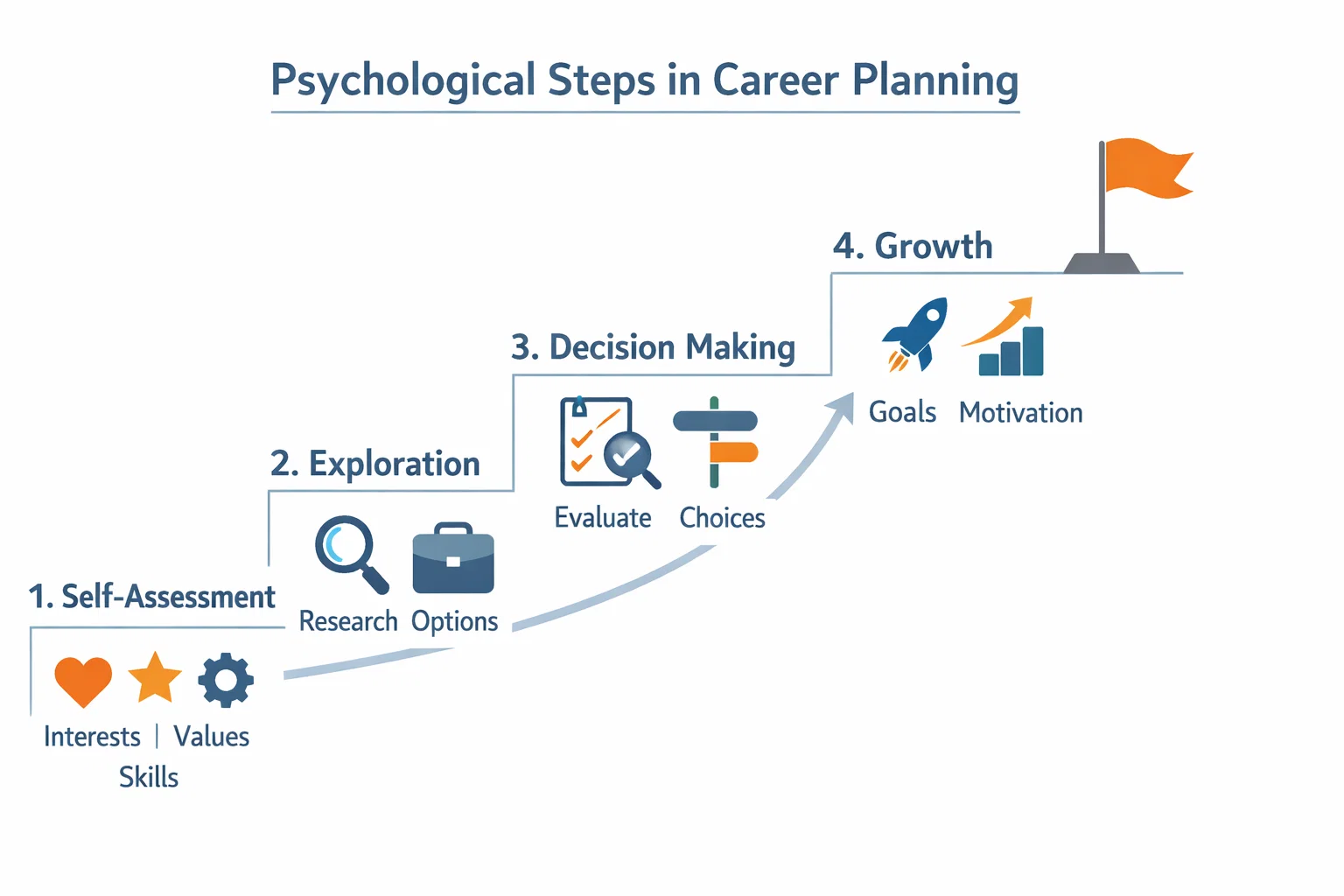
The Five Steps of Career Planning
Psychology-based career planning usually follows five core steps. These steps are not rigid. People may revisit them multiple times.
1. Self-assessment
This includes interests, strengths, weaknesses, personality traits, and values. Honest self-knowledge is the foundation of all planning.
2. Career exploration
This step involves learning about options without pressure. Psychology encourages curiosity over fear.
3. Decision-making
Choices are made by balancing desire, ability, and reality. Psychology helps manage doubt and perfectionism here.
4. Skill development
Goals become practical through learning and effort. Motivation theories explain how to stay consistent.
5. Evaluation and adjustment
Careers are reviewed and refined. Psychology normalizes change instead of framing it as failure.
These steps work best when guided by self-awareness, not comparison.
The Seven Steps in the Career Process
Some psychologists expand career planning into a broader seven-step process to reflect real life.
- Self-awareness
- Opportunity awareness
- Goal setting
- Decision-making
- Skill acquisition
- Implementation
- Review and adaptation
This model highlights something important. Careers do not move in straight lines. Psychology supports reflection and correction along the way.
People who skip reflection often feel stuck. Those who review their path grow faster and with less regret.
The Five Stages of Career Development Theory
Career development theories describe how career needs change across life stages. One well-known psychological framework outlines five stages.
Growth stage
Early life. Interests form through exposure, play, and learning.
Exploration stage
Adolescence to early adulthood. People test roles and imagine futures.
Establishment stage
Early career years. Skills develop and confidence builds.
Maintenance stage
Mid-career. Focus shifts to stability, mastery, and contribution.
Transition stage
Later life. People reflect, mentor, or redefine purpose.
Psychology helps people understand where they are instead of comparing themselves to others at different stages.
The Four Career Development Processes
Career development involves four ongoing psychological processes.
Exploration
Learning about self and options.
Decision-making
Choosing paths under uncertainty.
Implementation
Turning decisions into action.
Adjustment
Adapting to change and feedback.
These processes repeat throughout life. Psychology supports each one by strengthening awareness, confidence, and emotional balance.
The Role of Psychology in Career Success
Career success is often misunderstood. Psychology defines success beyond income or titles.
Psychological career success includes:
- Satisfaction with work
- Sense of purpose
- Emotional well-being
- Personal growth
- Balance between life roles
Research consistently shows that people who define success internally feel more fulfilled than those chasing external validation.
Psychology also explains habits behind success.
- Self-discipline over motivation
- Learning mindset over fixed identity
- Emotional regulation over impulsive reactions
Career success is less about talent and more about mental habits practiced daily.
The Four Purposes of Psychology in Career Life
Psychology serves four main purposes in understanding careers.
Understanding
Explains why people behave the way they do at work.
Prediction
Helps anticipate challenges and reactions.
Influence
Supports positive behavior change.
Well-being
Promotes mental health alongside achievement.
When applied to careers, these purposes help people build sustainable professional lives.
Five Goals of Psychology With Career Examples
Psychology sets clear goals that directly impact career development.
1. Self-understanding
Knowing strengths and limits helps choose suitable roles.
2. Skill development
Psychology explains how learning works best.
3. Emotional regulation
Managing stress improves performance.
4. Motivation enhancement
Understanding goals keeps effort consistent.
5. Social effectiveness
Improving communication strengthens teamwork and leadership.
These goals turn psychology into a practical career tool, not just theory.
Psychology of Career Success
The psychology of career success focuses on internal patterns that support long-term achievement.
Successful individuals often share psychological traits:
- Growth mindset
- Emotional resilience
- Clear values
- Self-reflection habits
- Willingness to adapt
Psychology also explains failure without shame. Career setbacks are information, not identity. People who learn from failure progress faster than those who fear it.
This shift alone changes how people approach work challenges.
Which Career Is Best in Psychology?
There is no single best career in psychology. The best choice depends on personality, interests, and values.
Common psychology-related careers include:
- Clinical psychology
- Counseling psychology
- Educational psychology
- Organizational psychology
- Research and academia
- Mental health advocacy
- Applied behavioral roles
Psychology teaches an important lesson here. Fit matters more than prestige. A well-matched career brings satisfaction even if it lacks social glamour.
Why Study Psychology? Ten Practical Reasons
People study psychology for many reasons. These ten stand out.
- Understand human behavior
- Improve communication
- Manage stress better
- Build emotional intelligence
- Support mental health
- Enhance leadership skills
- Make informed decisions
- Improve relationships
- Adapt to change
- Develop self-awareness
Psychology improves careers even when people do not become psychologists.
The Importance of Planning From a Psychological View
Planning serves six major psychological purposes.
- Reduces uncertainty
- Increases confidence
- Supports motivation
- Improves focus
- Prevents burnout
- Enhances life satisfaction
Planning does not remove risk. It strengthens the mind to face it.
Psychology as a Lifelong Career Companion
Careers are no longer linear. People change roles, industries, and identities. Psychology makes these changes manageable.
It helps people let go of outdated paths without guilt.
It supports rebuilding without panic.
It encourages growth without comparison.
Psychology does not promise certainty. It offers clarity.
Final Thoughts Without Finality
Career development is not about finding one perfect answer. It is about learning how to choose wisely again and again.
Psychology gives people tools to understand themselves, navigate uncertainty, and build careers that support mental health and purpose.
When career planning includes psychology, success feels less forced and more human.
FAQs:
What is the psychology of career development?
The psychology of career development studies how people choose, change, and grow in their careers over time. It looks at interests, personality, motivation, emotions, and life experiences to explain why people follow certain career paths and how they can adjust when needs change.
What is career planning in psychology?
Career planning in psychology is a structured process that helps individuals understand themselves, set realistic goals, and make informed career decisions. It focuses on self-awareness, decision-making skills, and emotional readiness rather than only job trends or salaries.
Why is it important to plan for a career in psychology?
Planning a career using psychological principles reduces confusion, stress, and burnout. It helps people align their work with their values, strengths, and mental well-being, leading to greater satisfaction and long-term stability.
What is the role of career planning?
The role of career planning is to provide direction, clarity, and purpose. It helps individuals set goals, prepare for challenges, develop skills, and adapt to changes throughout their working life.
What are the five steps of career planning?
The five steps of career planning are self-assessment, career exploration, decision-making, skill development, and evaluation. These steps help people move from understanding themselves to building and adjusting a realistic career path.
What are the six importance of planning?
Planning is important because it reduces uncertainty, increases confidence, improves focus, supports motivation, prevents burnout, and enhances overall life satisfaction. Psychological planning strengthens both career growth and mental health.
What is the role of psychology in your future career?
Psychology helps in understanding motivation, managing stress, improving communication, and making better decisions. These skills are essential for adapting to change and maintaining emotional balance in future careers.
What are the four purposes of psychology?
The four purposes of psychology are understanding behavior, predicting outcomes, influencing positive change, and improving well-being. In careers, these purposes help people perform better and stay mentally healthy.
Why study psychology? Give ten points.
Studying psychology helps people understand behavior, improve communication, manage stress, build emotional intelligence, support mental health, strengthen leadership, make better decisions, improve relationships, adapt to change, and develop self-awareness.
What are the seven steps in the career process?
The seven steps include self-awareness, opportunity awareness, goal setting, decision-making, skill development, implementation, and review. These steps reflect how careers evolve over time rather than following a single fixed path.
What are the five stages of career development theory?
The five stages are growth, exploration, establishment, maintenance, and transition. Each stage represents changing needs, goals, and motivations across different phases of life.
What are the four career development processes?
The four main processes are exploration, decision-making, implementation, and adjustment. Psychology supports these processes by strengthening confidence, flexibility, and self-reflection.
Which career is best in psychology?
There is no single best career in psychology. The right choice depends on interests and personality. Common paths include clinical psychology, counseling, educational psychology, organizational psychology, research, and applied mental health roles.

Muhammad Nawaz is the founder of Psyvanta.com and writes simple, practical psychology content for South Asian readers. He focuses on real-life problems like stress, motivation, relationships, and daily mental well-being, turning research into clear advice people can actually use.