Group dynamics in the workplace refers to the patterns of interaction, communication, and influence within teams. It matters because these patterns shape trust, decision-making, and performance. As work becomes more collaborative and remote, understanding and guiding group dynamics will remain central to effective leadership and sustainable teamwork.

Group Dynamics Explained:
| Aspect | Explanation |
|---|---|
| Definition | How team members interact, communicate, and influence each other |
| Why it matters | Affects trust, conflict, productivity, and morale |
| Key stages | Forming, storming, norming, performing, adjourning |
| Core elements | Communication, roles, leadership, norms, emotions |
| Practical impact | Better decisions, lower stress, stronger performance |
| Current relevance | Essential for modern, hybrid, and remote teams |
Teams are not just collections of people doing tasks side by side. They are living systems. They react, adapt, resist, and grow. Every workplace team develops patterns of behavior, whether anyone plans it or not. These patterns decide who speaks, who stays quiet, how conflict shows up, and how decisions actually get made. That is group dynamics in action.
Studies in organizational psychology consistently show that teams with healthy group dynamics perform better, experience less burnout, and stay together longer. At the same time, many workplace problems blamed on “attitude” or “lack of motivation” are really symptoms of broken group dynamics. When the system is unhealthy, even capable people struggle.
Here’s what matters. You cannot fix teams by focusing only on individuals. You have to understand how the group works as a whole. Once you see the patterns clearly, improvement becomes possible.
What Is Group Dynamics in the Workplace?
Group dynamics refers to the psychological forces that influence how people behave when they work together. It includes communication styles, emotional reactions, power relationships, shared expectations, and unspoken rules.
In a workplace setting, group dynamics shape everyday experiences. Who feels safe sharing ideas. How feedback is given or avoided. Whether mistakes are treated as learning moments or failures. These dynamics operate quietly, but their impact is loud.
A team may look calm on the surface while tension builds underneath. Another team may openly disagree yet remain deeply connected and productive. The difference is not personality. It is the quality of the group dynamics.
Understanding this concept helps leaders and team members stop personalizing problems that are actually systemic.
Why Understanding Group Dynamics Is Important
Most workplace conflicts are not caused by bad intentions. They grow from unclear roles, unmet expectations, and poor communication habits. When these issues are ignored, frustration turns into withdrawal, resentment, or silent resistance.
Understanding group dynamics allows organizations to intervene early. Instead of blaming people, they can adjust structures, norms, and leadership behavior. This shift alone reduces stress and improves morale.
There is also a performance angle. Teams with healthy dynamics make better decisions because members feel safe challenging ideas. They adapt faster because feedback flows freely. They recover from setbacks because trust already exists.
Bottom line. You cannot build strong performance on weak relationships.
The Five Key Elements of Group Dynamics
Every workplace team is shaped by five essential elements. When these are balanced, teams thrive. When one is weak, cracks appear.
Communication
Communication is not just about talking. It is about clarity, listening, and timing. Teams with strong communication share information openly and respectfully. Teams with poor communication rely on assumptions and indirect messages.
Roles and Responsibilities
Unclear roles create conflict faster than personality differences. When people do not know who owns what, frustration builds. Clear roles reduce overlap, defensiveness, and power struggles.
Leadership Influence
Leaders shape group dynamics through behavior more than words. How they respond to mistakes, disagreement, or silence sets the emotional tone. Teams watch closely, even when leaders think they are not.
Group Norms
Norms are unwritten rules. How meetings run. How feedback is given. How late is acceptable. These norms guide behavior more strongly than formal policies.
Emotional Climate
This is the overall feeling of the team. Is it tense, relaxed, cautious, or supportive? Emotional climate directly affects motivation and mental well-being.
Strong teams pay attention to all five. Weak teams focus only on results and ignore the human system producing them.
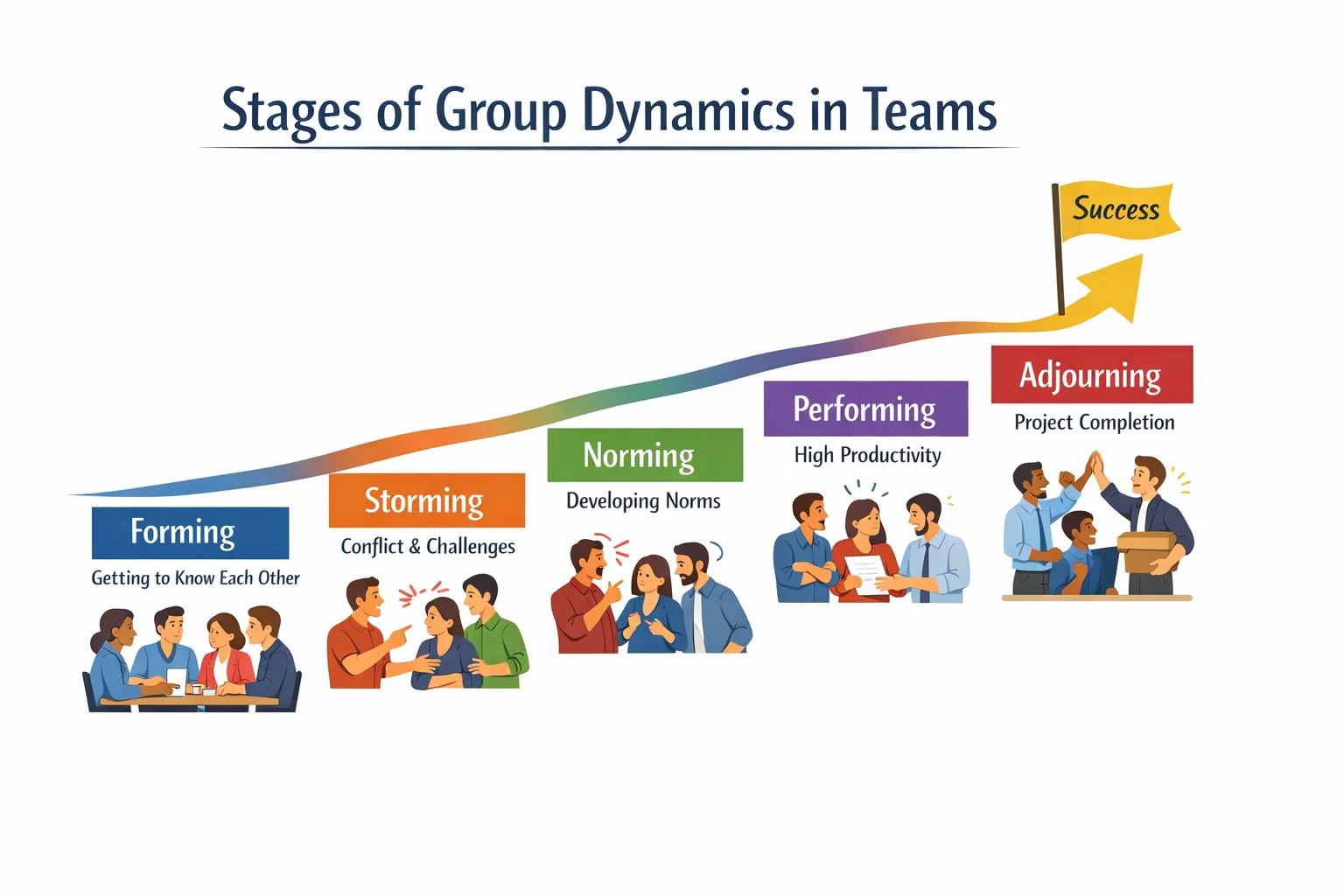
The Five Stages of Group Dynamics
Most workplace teams move through predictable stages as they develop. These stages explain why teams feel unstable before they feel strong.
| Stage | What Happens in the Team |
|---|---|
| Forming | Team members are polite, cautious, and unsure about roles and expectations |
| Storming | Conflicts emerge, differences surface, and power struggles may appear |
| Norming | Trust builds, roles become clear, and cooperation improves |
| Performing | The team works efficiently with strong collaboration and focus |
| Adjourning | Tasks are completed, and the team reflects and disengages |
Forming
At this stage, people are polite and cautious. Roles are unclear. Members look to leadership for direction. Productivity is usually low but expectations are high.
Storming
This is where conflict emerges. Differences surface. Power struggles may appear. Many teams get stuck here because conflict feels uncomfortable. In reality, this stage is necessary.
Norming
Here, teams begin to settle. Rules become clear. Trust grows. Members understand each other’s strengths and limits. Cooperation improves naturally.
Performing
This is the stage everyone wants, but it cannot be rushed. Teams here are focused, flexible, and productive. Conflict still exists, but it is handled constructively.
Adjourning
In project-based teams, this final stage involves closure. Reflection, recognition, and emotional processing matter more than people realize.
The most crucial stage is norming. Without healthy norms, high performance cannot last.
The Four Functions of Group Dynamics
Group dynamics serve four major functions inside organizations.
Task Achievement
Teams exist to get work done. Dynamics influence how efficiently tasks are completed and how problems are solved.
Emotional Support
Workplaces are emotional environments. Teams provide validation, encouragement, and stress relief when dynamics are healthy.
Identity and Belonging
People derive part of their identity from their teams. Feeling valued increases commitment and responsibility.
Decision Coordination
Teams help align individual efforts toward shared goals. Poor dynamics lead to confusion and duplicated effort.
Ignoring any one of these functions weakens the entire system.
The Four Dimensions of Group Dynamics
Psychologists often describe group dynamics using four dimensions.
Task Dimension
Focus on goals, deadlines, and performance standards.
Social Dimension
Quality of relationships, trust, and emotional bonds.
Power Dimension
How influence and authority are distributed and used.
Communication Dimension
How information flows and feedback is exchanged.
Balanced teams manage all four. Overemphasis on task without social care leads to burnout. Too much focus on harmony without clarity reduces accountability.
Types of Group Dynamics
There are two broad types of group dynamics in workplaces.
Positive Group Dynamics
These encourage cooperation, learning, trust, and shared responsibility. Mistakes are discussed openly. Feedback is specific and respectful.
Negative Group Dynamics
These create fear, silence, blame, or unhealthy competition. People protect themselves instead of contributing fully.
Teams often shift between these types depending on leadership behavior and stress levels.
Signs of Poor Team Dynamics
Poor dynamics rarely announce themselves loudly. They show up subtly.
Common signs include silence in meetings, repeated misunderstandings, gossip, passive resistance, low engagement, and blame shifting. Productivity may continue for a while, but energy steadily drains.
One of the clearest signs is avoidance. When people stop raising concerns, the team is already in trouble.
Benefits of Strong Teamwork
Strong group dynamics bring measurable benefits.
Teams solve problems faster because ideas flow freely. Motivation increases because people feel valued. Stress decreases because support is available. Innovation improves because risk feels safer.
Other benefits include trust, accountability, learning, resilience, satisfaction, and long-term performance.
These outcomes are not accidental. They are the result of intentional attention to group dynamics.
The Five Steps to Build a Strong Team
Building healthy dynamics takes time, but the steps are simple.
First, clarify purpose. Teams need a shared understanding of why they exist.
Second, define roles clearly. Ambiguity breeds conflict.
Third, establish norms together. Shared rules create ownership.
Fourth, encourage open communication. Silence is data, not peace.
Fifth, review and adjust regularly. Teams evolve, and dynamics shift.
Consistency matters more than perfection.
How Leaders Can Improve Group Dynamics
Leaders are the strongest influence on group dynamics. Their behavior shapes safety, trust, and accountability.
Effective leaders listen actively and invite diverse perspectives. They address conflict early instead of avoiding it. They model respectful disagreement and emotional regulation.
They also create psychological safety. People are more willing to contribute when mistakes are treated as learning opportunities, not threats.
Leadership is not about control. It is about shaping conditions where people can work at their best.
Activities to Improve Team Dynamics
Simple activities can reset unhealthy patterns when used thoughtfully.
Regular reflection sessions help teams discuss what is working and what is not. Role-clarity discussions reduce tension caused by overlap. Structured feedback circles improve communication skills.
The key is consistency. One-off activities rarely change deep patterns.
Principles of Group Dynamics
Two principles guide all group dynamics.
First, behavior is influenced more by context than personality. Change the environment, and behavior changes.
Second, unspoken rules are more powerful than written ones. What teams tolerate becomes the norm.
Understanding these principles shifts the focus from blame to design.
Four Types of Groups in Organizational Behaviour
Workplaces typically include four types of groups.
Formal groups are created by the organization.
Informal groups form naturally through relationships.
Task groups focus on specific goals.
Social groups provide emotional connection.
Each group influences behavior in different ways. Ignoring informal and social groups is a common leadership mistake.
Final Perspective
Understanding group dynamics in the workplace is not about fixing people. It is about understanding systems. Teams succeed or struggle based on patterns that develop over time.
When leaders and team members learn to see these patterns clearly, change becomes practical instead of personal. Communication improves. Conflict becomes manageable. Performance follows naturally.
Strong teams are not lucky. They are designed with awareness, care, and consistency.
FAQs:
What is group dynamics in the workplace?
Group dynamics in the workplace refers to how people interact, communicate, and influence one another within a team. It includes behavior patterns, emotional responses, roles, power balance, and unspoken rules that shape how work actually gets done.
Why is understanding group dynamics important?
Understanding group dynamics helps teams reduce conflict, improve communication, and increase performance. It allows leaders to fix system-level issues instead of blaming individuals, which leads to healthier and more productive workplaces.
What are the five key elements of group dynamics?
The five key elements of group dynamics are communication, roles and responsibilities, leadership influence, group norms, and emotional climate. When these elements are balanced, teams function smoothly and efficiently.
What are the five stages of group dynamics?
The five stages are forming, storming, norming, performing, and adjourning. Each stage reflects how a team grows over time, with conflict being a normal and necessary part of development.
Which stage of group dynamics is the most crucial?
The norming stage is the most crucial because this is where trust, shared rules, and cooperation are established. Without healthy norms, long-term performance is difficult to sustain.
What are the four functions of group dynamics?
Group dynamics serve four main functions: completing tasks, providing emotional support, creating a sense of belonging, and coordinating decisions within a team.
What are the two types of group dynamics?
The two types are positive group dynamics and negative group dynamics. Positive dynamics encourage trust and collaboration, while negative dynamics lead to fear, silence, and conflict.
What are the four dimensions of group dynamics?
The four dimensions are task-related behavior, social relationships, power and influence, and communication flow. Strong teams maintain balance across all four dimensions.
What are common signs of poor team dynamics?
Signs include silence in meetings, low engagement, repeated misunderstandings, blame-shifting, lack of trust, and avoidance of feedback or responsibility.
What are some activities to improve team dynamics?
Activities such as reflection meetings, role-clarity discussions, structured feedback sessions, and open team conversations help improve trust and communication when done consistently.
How can leaders improve group dynamics?
Leaders can improve group dynamics by listening actively, addressing conflict early, setting clear expectations, modeling respectful behavior, and creating psychological safety within the team.
What are the four types of groups in organizational behaviour?
The four types are formal groups, informal groups, task groups, and social groups. Each type influences employee behavior and workplace culture in different ways.
What are the two main principles of group dynamics?
First, group behavior is shaped more by environment than personality. Second, unspoken rules guide behavior more strongly than written policies.

Muhammad Nawaz is the founder of Psyvanta.com and writes simple, practical psychology content for South Asian readers. He focuses on real-life problems like stress, motivation, relationships, and daily mental well-being, turning research into clear advice people can actually use.