
 Organizations today face constant pressure to adapt. New technology, economic uncertainty, artificial intelligence, remote work, and changing employee expectations are reshaping workplaces around the world. Yet research repeatedly shows that most organizational change efforts fail because leaders focus only on systems, policies, and targets while ignoring human psychology.
A study published by McKinsey found that nearly 70% of change initiatives fail due to employee resistance and weak management support. This statistic highlights an important reality: successful change management is not only about planning. It is about understanding human emotions, behavior, fear, trust, and motivation.
Psychological strategies for effective change management help organizations guide employees through uncertainty with less stress and stronger cooperation. These strategies focus on emotional safety, communication, leadership behavior, and mental resilience. When people feel heard, respected, and emotionally supported, they are more willing to adapt to new systems and expectations.
Modern workplaces cannot rely only on authority-driven leadership anymore. Employees now expect transparency, empathy, and participation during periods of transition. Organizations that understand this human need often experience smoother adaptation, stronger morale, and better long-term performance.
This article explains the psychological foundations behind effective change management. It also covers proven models like Kurt Lewin’s 3-step model, the 5 C’s and 7 C’s of change management, emotional intelligence in leadership, communication psychology, and practical ways organizations can reduce employee stress during transitions.
Why Change Feels Threatening to the Human Brain
Human beings naturally prefer familiarity. The brain is designed to conserve energy and protect against uncertainty. When routines suddenly change, the brain often interprets the situation as a possible threat.
This reaction happens because uncertainty activates stress responses in the nervous system. Employees may begin worrying about job security, performance expectations, social relationships, or their ability to succeed under new systems.
Even positive changes can trigger emotional discomfort. A promotion may create anxiety about higher responsibility. New workplace software may cause fear of failure. Remote work flexibility may increase feelings of isolation for some employees.
Psychologists often connect this resistance to concepts like loss aversion and cognitive dissonance. People tend to fear losing what feels comfortable, even if the new option could eventually improve their lives.
Employees may not openly say they fear change. Instead, resistance often appears through behaviors such as:
- Reduced motivation
- Increased complaints
- Avoiding participation
- Emotional withdrawal
- Delayed cooperation
- Workplace conflict
- Higher absenteeism
Leaders who misunderstand these reactions sometimes label employees as “difficult” or “unmotivated.” In reality, many employees are simply experiencing emotional stress caused by uncertainty.
Understanding this psychological reality changes how organizations approach change management. Instead of forcing immediate compliance, effective leaders focus on emotional adaptation first.
The Psychology Behind Successful Change Management
Successful change management works because it respects human emotional needs alongside business goals.
People adapt more effectively when they feel psychologically safe. Psychological safety means employees believe they can ask questions, express concerns, and make mistakes without humiliation or punishment.
This matters because fear blocks learning. When employees feel emotionally threatened, the brain focuses more on protection than growth. Creativity, communication, and collaboration often decrease under high stress.
Psychology also shows that motivation improves when people understand meaning behind change. Employees want to know:
- Why is this happening?
- How will this affect me?
- Will I receive support?
- What benefits will this create?
- What happens if I struggle?
Clear answers reduce anxiety because the brain prefers predictability over confusion.
Behavioral psychology further explains that gradual reinforcement improves adaptation. Small wins help employees gain confidence with new systems. Positive feedback strengthens motivation and reduces emotional exhaustion.
Trust is another critical psychological factor. Employees are more willing to follow leaders who communicate honestly during uncertainty. When leaders hide information or give inconsistent messages, employees often assume the worst.
Organizations that succeed with change management usually create environments where employees feel emotionally respected instead of controlled.
What Are the Five Effective Change Management Strategies?
Several psychological strategies consistently improve organizational change outcomes. These methods focus on reducing emotional resistance while building trust and cooperation.
Clear and Honest Communication
Communication is one of the strongest psychological tools during change. Employees fear uncertainty more than difficult truths. Honest communication helps reduce rumors and emotional confusion.
Leaders should explain:
- Why change is necessary
- What the organization hopes to achieve
- How employees may be affected
- What support systems are available
- What timelines employees can expect
Simple language works better than corporate jargon. Employees connect more with authentic communication than polished business slogans.
Employee Participation
People support what they help create. Involving employees in discussions and decision-making increases emotional ownership.
Participation may include:
- Feedback meetings
- Surveys
- Small group discussions
- Pilot programs
- Employee suggestions
When employees feel included, resistance often decreases naturally.

Emotional Support and Empathy
Change creates emotional strain. Organizations that acknowledge stress openly often build stronger loyalty.
Support may include:
- Counseling services
- Flexible schedules
- Mental health workshops
- Supportive leadership conversations
- Peer mentoring
Empathy does not weaken leadership. It strengthens trust.
Leadership Consistency
Employees carefully observe leadership behavior during uncertain periods. Calm, stable leadership creates emotional reassurance.
If leaders appear confused, defensive, or emotionally reactive, employees often lose confidence in the process.
Consistency between words and actions is essential.
Continuous Training and Reinforcement
Employees fear feeling incompetent during change. Training reduces anxiety by increasing confidence and capability.
Organizations should avoid one-time training sessions only. Ongoing reinforcement helps employees gradually adapt without feeling overwhelmed.
Understanding Kurt Lewin’s 3 Step Model
Kurt Lewin’s 3-step model remains one of the most influential psychological frameworks in change management. Developed by psychologist Kurt Lewin in the 1940s, the model focuses on how human behavior adapts during transitions.
The model includes three stages:
- Unfreeze
- Change
- Refreeze
Although simple, the framework remains highly effective because it recognizes emotional adjustment as part of organizational change.
Unfreeze Stage
The unfreeze stage prepares people mentally and emotionally for change.
At this stage, leaders explain why existing systems can no longer continue. Employees need time to emotionally process the reality that familiar routines may disappear.
Without proper preparation, employees may enter denial or resistance.
Effective unfreezing includes:
- Honest communication
- Explaining risks of staying the same
- Building urgency carefully
- Encouraging open discussion
- Addressing fears respectfully
This stage reduces emotional attachment to old systems gradually instead of forcing sudden disruption.
Change Stage
The change stage introduces new behaviors, systems, or structures.
This phase is often emotionally difficult because employees leave familiar routines but have not yet fully adjusted to new expectations.
Common emotional reactions during this stage include:
- Confusion
- Anxiety
- Frustration
- Low confidence
- Mental fatigue
Leaders should provide strong emotional and practical support during implementation.
Helpful strategies include:
- Training sessions
- Coaching
- Emotional encouragement
- Frequent communication
- Patience with mistakes
Organizations that rush this stage often increase resistance and burnout.
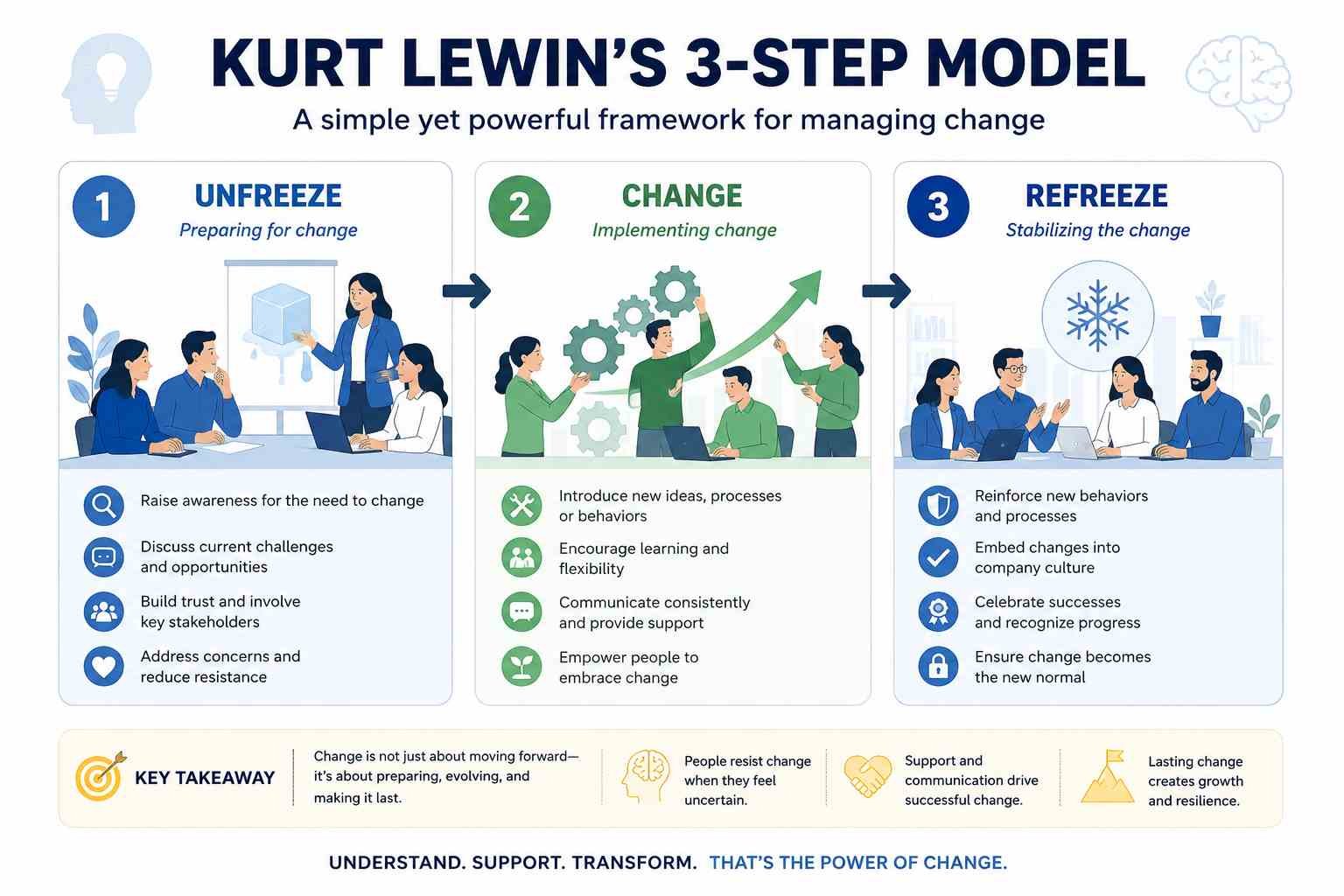
Refreeze Stage
The refreeze stage stabilizes the new system.
Employees psychologically need predictability after periods of uncertainty. Refreezing helps new habits become normal parts of workplace culture.
Organizations reinforce change through:
- Recognition
- Positive feedback
- Updated policies
- Ongoing support
- Cultural integration
Without this stage, employees may return to older behaviors because the new system never fully feels secure.
What Are the 5 C’s of Change Management?
The 5 C’s of change management create a practical framework for guiding organizational transitions successfully.
Communication
Frequent communication reduces fear and misinformation. Employees should receive updates regularly, even when all answers are not yet available.
Commitment
Leaders and employees must remain emotionally committed to the long-term goal of the change process.
Weak leadership commitment quickly damages trust.
Culture
Organizational culture strongly influences how employees respond to change. Healthy workplace cultures adapt more easily because trust already exists.
Capability
Employees need the right knowledge, skills, and emotional readiness to succeed under new systems.
Capability includes both technical training and psychological support.
Confidence
Confidence grows when employees feel capable, supported, and valued during transitions.
Organizations that strengthen employee confidence often experience lower resistance and higher morale.
What Are the 7 C’s of Change Management?
The 7 C’s expand further on emotional and organizational dynamics during change.
Clarity
Employees need clear goals, expectations, and direction.
Confusion increases emotional stress.
Communication
Transparent communication prevents harmful rumors and misunderstandings.
Collaboration
Teamwork improves adaptation because employees support each other emotionally and practically.
Commitment
Leaders must stay engaged throughout the process instead of disappearing after announcements.
Consistency
Stable leadership behavior creates emotional reassurance.
Culture
A positive workplace culture increases resilience during uncertainty.
Compassion
Compassionate leadership recognizes that change affects people emotionally, not just professionally.
This human-centered approach improves long-term organizational trust.
Emotional Intelligence in Change Leadership
Emotional intelligence plays a major role in successful leadership during periods of change.
Emotionally intelligent leaders recognize emotional patterns in themselves and others. They understand how stress affects communication, behavior, and teamwork.
Self-awareness helps leaders regulate their own reactions under pressure. Employees often mirror leadership emotions. Calm leaders usually create calmer teams.
Empathy is equally important. Employees want leaders who genuinely listen instead of dismissing concerns.
Emotionally intelligent leadership includes:
- Active listening
- Emotional patience
- Respectful communication
- Self-control
- Honest feedback
- Adaptability
Organizations with emotionally intelligent leaders often experience:
- Better morale
- Reduced workplace anxiety
- Stronger employee loyalty
- Faster adaptation
- Improved collaboration
Employees may forget exact words leaders say during change, but they often remember how leadership made them feel emotionally.
Communication Psychology During Organizational Change
Communication influences emotional interpretation.
Two employees can hear the same announcement but react very differently depending on tone, trust, and delivery style.
Psychology research shows people process emotional meaning before logical details. This means leadership tone matters greatly during change communication.
Poor communication creates:
- Fear
- Rumors
- Mistrust
- Confusion
- Emotional withdrawal
Strong communication creates:
- Clarity
- Stability
- Cooperation
- Confidence
- Emotional reassurance
Effective communication strategies include:
- Speaking honestly
- Using simple language
- Allowing questions
- Giving regular updates
- Acknowledging uncertainty openly
Leaders should also avoid overwhelming employees with excessive information at once. Gradual communication often reduces stress more effectively.
Nonverbal communication matters too. Facial expressions, posture, and tone strongly influence emotional perception.
Employees notice emotional inconsistency quickly.
How Workplace Culture Affects Mental Health During Change
Workplace culture shapes emotional resilience during transitions.
In supportive cultures, employees feel safer expressing concerns and seeking help. In toxic cultures, uncertainty often increases fear and emotional exhaustion.
Stress during organizational change may lead to:
- Anxiety
- Sleep problems
- Emotional fatigue
- Workplace conflict
- Reduced concentration
- Burnout symptoms
Healthy workplace cultures often encourage:
- Respectful communication
- Team collaboration
- Emotional openness
- Psychological safety
- Work-life balance
Organizations that prioritize mental health usually experience smoother adaptation during transitions.
Supportive practices may include:
- Wellness programs
- Counseling services
- Flexible work arrangements
- Stress management training
- Mental health education
Employees perform better when emotional well-being is protected.
Psychological Techniques That Reduce Employee Stress
Organizations can use several evidence-based psychological methods to help employees cope with workplace transitions.
Cognitive Reframing
Cognitive reframing helps employees reinterpret change more positively.
Instead of viewing change as danger, employees learn to see it as growth, learning, or opportunity.
This reduces emotional resistance.
Gradual Exposure
Large changes introduced too quickly often overwhelm employees psychologically.
Step-by-step implementation allows employees to adapt gradually.
Positive Reinforcement
Recognition encourages adaptive behavior.
Simple appreciation and acknowledgment strengthen confidence and motivation.
Active Listening
Employees feel emotionally safer when leaders genuinely listen without interruption or defensiveness.
Feeling heard reduces frustration.
Stress Reduction Practices
Short wellness breaks, mindfulness sessions, and supportive conversations improve emotional regulation during uncertain periods.
Even small mental health practices can improve workplace resilience significantly.
Real-World Examples of Psychology-Based Change Management
Many successful organizations already use psychology-centered approaches.
Technology companies often involve employees early before implementing new systems. Hospitals increasingly provide emotional support programs during policy transitions to reduce staff burnout.
Educational institutions also use behavioral psychology when introducing digital learning tools. Teachers adapt more successfully when training combines practical instruction with emotional support.
One consistent lesson appears across industries: people adapt better when leaders prioritize emotional well-being alongside operational goals.
Organizations that ignore emotional factors may temporarily force compliance, but long-term morale and trust often suffer.
The Future of Change Management Psychology
Workplaces are changing faster than ever before. Artificial intelligence, automation, hybrid work, and global uncertainty continue reshaping organizations worldwide.
This means psychological strategies for effective change management will become even more important in the future.
Modern organizations are increasingly focusing on:
- Emotional resilience
- Mental health support
- Human-centered leadership
- Psychological safety
- Digital stress management
- Flexible workplace adaptation
Future change management will likely combine psychology, neuroscience, leadership science, and technology to create healthier organizational environments.
Here’s what matters most: change management succeeds when leaders remember that employees are human beings first.
People do not resist change simply because they dislike improvement. Most resistance comes from uncertainty, fear, emotional exhaustion, or lack of trust.
Organizations that understand human psychology create workplaces where employees feel respected, supported, and emotionally secure during times of transition.
That is the real foundation of effective change management.

M.Phil in Psychology from UET Lahore, Sajid Ali shares clear, research-based insights on mental health, emotions, and social behavior in simple English. Sajid Ali draws on hands-on academic research and real-life observations of emotional and social behavior, turning psychological theory into clear, practical insight for everyday readers.