
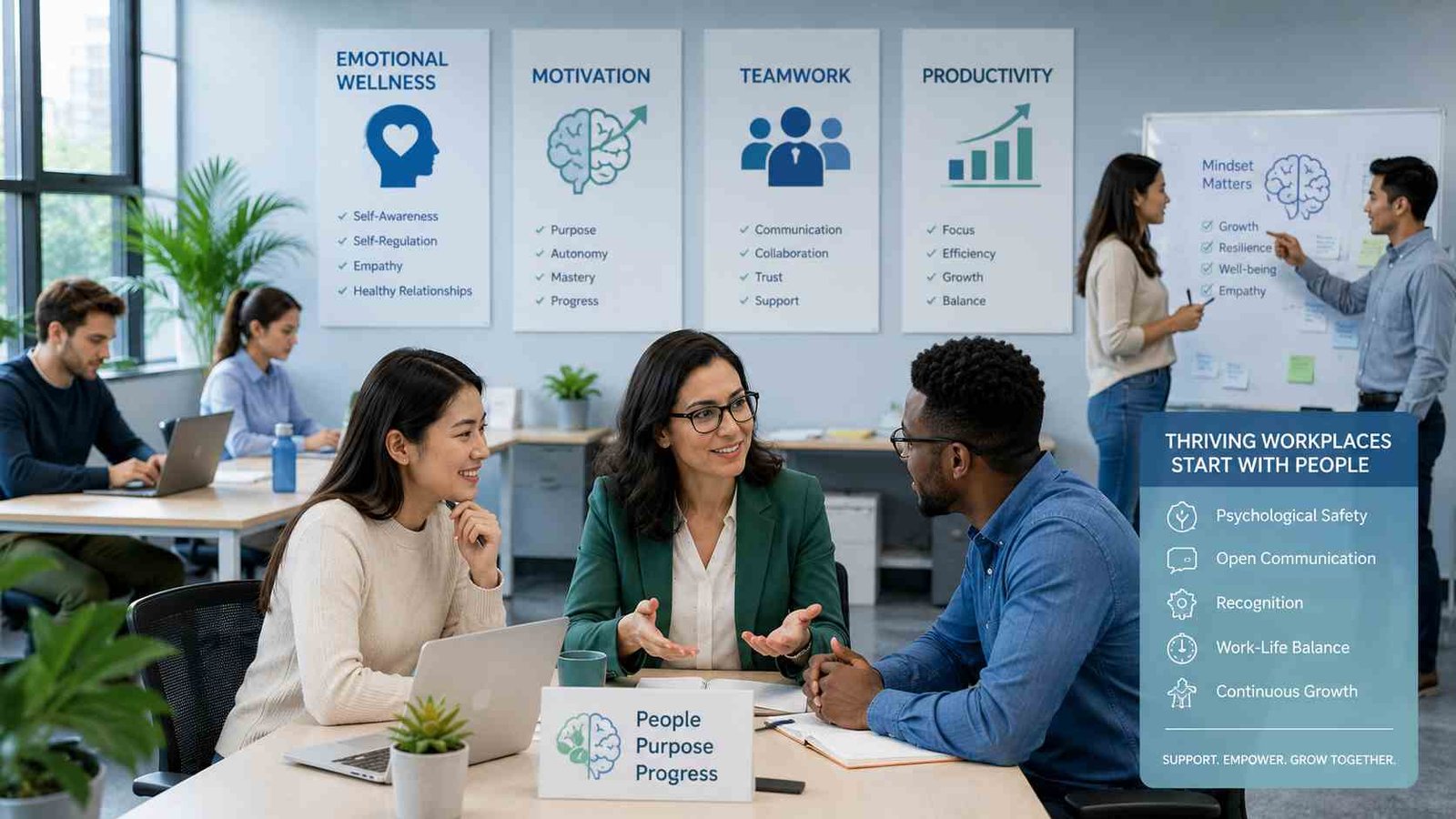
 Modern workplaces are changing fast. Companies invest heavily in technology, automation, and performance systems, yet many still struggle with low employee motivation, burnout, and poor teamwork. Here’s what matters: productivity is not only a business issue. It is deeply connected to human psychology.
A report from the World Health Organization estimated that depression and anxiety cost the global economy nearly $1 trillion every year in lost productivity. At the same time, workplaces that support employee well-being often experience stronger performance, lower turnover, and better collaboration. This shift has pushed psychology into the center of modern organizational success.
The role of psychology in enhancing employee productivity is now more important than ever. Businesses increasingly rely on psychological principles to improve focus, communication, motivation, emotional safety, and workplace relationships. Employees are not machines. They are human beings with emotions, stress, goals, habits, and social needs that directly affect how they perform.
Psychology helps organizations understand why some teams thrive while others struggle. It explains how motivation works, why stress reduces performance, and how leadership behavior shapes employee morale. Most importantly, it gives practical solutions that help people work better without destroying their mental health.
Understanding the Psychology of Productivity
The psychology of productivity studies how thoughts, emotions, habits, and behavior affect a person’s ability to complete work effectively. Productivity is not simply about working longer hours. In many cases, mental clarity, emotional balance, and motivation matter far more than time spent at a desk.
Many employees struggle because their brains are overloaded. Constant notifications, multitasking, stress, and unrealistic deadlines reduce concentration. When the brain stays under pressure for too long, focus weakens and mistakes increase. Employees may appear busy while actually becoming mentally exhausted.
Psychologists explain that productivity depends on several mental factors:
| Psychological Factor | Effect on Productivity |
|---|---|
| Motivation | Increases energy and commitment |
| Emotional Stability | Improves focus and decision-making |
| Sleep and Rest | Supports memory and concentration |
| Positive Work Relationships | Reduces stress and conflict |
| Clear Goals | Improves direction and consistency |
Employees who feel emotionally supported often show stronger problem-solving skills and better creativity. On the other hand, workers who feel ignored or constantly criticized may slowly lose confidence and motivation.
This is why psychology focuses heavily on workplace behavior patterns. It studies how habits develop, why procrastination happens, and what helps people maintain consistency during stressful periods.
One important psychological principle is cognitive load. The human brain can only process a limited amount of information at once. Employees who constantly switch between tasks often experience mental fatigue faster than those working with structured priorities.
Another major factor is emotional regulation. Workers who manage emotions effectively usually stay calmer under pressure and recover faster from setbacks. Emotional intelligence plays a huge role here because it affects communication, teamwork, and stress management.
Productivity also depends on meaning. Employees are more engaged when they understand why their work matters. A person who feels connected to company goals often performs with greater energy and commitment compared to someone who feels emotionally disconnected from the workplace.
What Is the Role of Psychology in Improving Employee Performance?
Psychology helps organizations understand employee behavior in ways that improve performance without relying only on pressure or strict control. Instead of treating workers like production tools, psychology recognizes emotional and mental needs that influence workplace success.
One major contribution of psychology is improving motivation. Employees work better when they feel respected, appreciated, and emotionally safe. Recognition from managers can increase confidence and strengthen commitment to work goals.
Psychology also helps managers identify performance barriers. Sometimes poor performance is not caused by laziness. It may result from stress, unclear expectations, fear of failure, or communication problems. When leaders understand these psychological causes, they can respond more effectively.
Organizational psychologists often focus on areas like:
- Employee engagement
- Team communication
- Leadership behavior
- Workplace stress
- Decision-making
- Conflict resolution
- Emotional intelligence
For example, employees who receive constructive feedback usually improve faster than workers who face public criticism. The human brain responds strongly to emotional experiences. Harsh environments increase anxiety, while supportive environments increase confidence.
Psychology also improves employee training. People learn differently depending on personality, attention span, and motivation levels. Training programs based on psychological learning principles often produce stronger long-term results.
Another important area is employee satisfaction. Research consistently shows that satisfied employees tend to stay longer, collaborate better, and contribute more creatively. Companies with healthier workplace cultures often experience lower absenteeism and higher productivity.
Workplace psychology also supports diversity and inclusion. Employees from different backgrounds may communicate differently or respond to stress in unique ways. Psychological awareness helps organizations create respectful environments where people feel valued regardless of culture or personality.
Leadership decisions also improve through psychology. Managers who understand emotional behavior are better at handling difficult conversations, motivating teams, and reducing workplace tension.
Bottom line: psychology improves employee performance because it helps organizations understand the human side of work instead of focusing only on output numbers.
The Connection Between Mental Health and Workplace Productivity
Mental health affects nearly every part of workplace performance. Employees dealing with anxiety, depression, emotional exhaustion, or chronic stress often struggle with concentration, memory, communication, and decision-making.
Mental fatigue can quietly reduce productivity even before visible signs appear. A worker may still attend meetings and complete tasks while mentally feeling disconnected and overwhelmed.
Burnout has become one of the biggest workplace concerns worldwide. Burnout usually develops after long periods of emotional pressure, excessive workloads, or lack of recovery time. Symptoms often include:
- Constant exhaustion
- Reduced motivation
- Irritability
- Low concentration
- Emotional numbness
- Declining work quality
Psychologists explain that the brain cannot remain under high stress indefinitely without consequences. Chronic stress increases cortisol levels, which affects memory, focus, and emotional regulation.
Employees with poor mental health may also avoid communication, struggle with teamwork, or feel emotionally detached from their responsibilities. This creates hidden organizational costs through lower efficiency and higher turnover.
At the same time, workplaces that prioritize mental wellness often experience noticeable improvements in productivity. Employees feel safer, more engaged, and emotionally stable when companies provide support systems.
Healthy workplace practices may include:
- Flexible schedules
- Mental health counseling
- Wellness programs
- Reasonable workloads
- Breaks and recovery time
- Respectful communication
- Work-life balance support
Mental health support also reduces stigma. Many employees hesitate to discuss emotional struggles because they fear judgment or career damage. Supportive workplaces help normalize these conversations.
Remote work has added another psychological challenge. Many employees now experience social isolation, blurred work-life boundaries, and digital fatigue. Organizations increasingly rely on psychology to help workers adapt to these changes in healthier ways.
The connection between mental health and productivity is now impossible to ignore. Employees perform better when their minds are healthy, rested, and emotionally supported.
Psychological Safety and Why It Matters at Work
Psychological safety means employees feel safe expressing ideas, asking questions, and admitting mistakes without fear of humiliation or punishment. This concept has become one of the most important topics in workplace psychology.
In psychologically unsafe environments, employees often remain silent even when they notice serious problems. Fear blocks communication. Workers may avoid sharing creative ideas because they worry about criticism or embarrassment.
Google’s workplace research project, often called Project Aristotle, found that psychological safety was one of the strongest factors behind successful teams.
When employees feel psychologically safe, they are more likely to:
- Share ideas openly
- Collaborate honestly
- Ask for help
- Report mistakes early
- Participate in discussions
- Support innovation
Fear damages productivity more than many managers realize. Employees under constant fear often focus more on avoiding mistakes than doing meaningful work.
Psychological safety begins with leadership behavior. Managers who listen respectfully and avoid public humiliation create stronger trust within teams.
Small daily behaviors matter greatly. Simple actions like acknowledging employee opinions, encouraging respectful discussion, and responding calmly to mistakes can build emotional safety over time.
This environment also improves learning. Employees who feel safe are more willing to experiment, ask questions, and develop new skills.
Psychological safety becomes even more important in multicultural workplaces where communication styles and social expectations may differ.
Strong psychological safety creates healthier teamwork because employees trust that they can speak honestly without emotional punishment.
Understanding the 5 C’s of Psychological Safety
The 5 C’s of psychological safety provide a practical framework for building emotionally secure workplaces.
Clarity
Employees need clear expectations, goals, and communication. Confusion creates stress and uncertainty. Workers perform better when they understand their responsibilities and workplace standards.
Consistency
Trust grows when leaders behave predictably and fairly. Employees feel emotionally safer when managers apply rules consistently instead of reacting emotionally or unfairly.
Contribution
Workers want to feel their ideas matter. Encouraging participation increases engagement and creativity. Employees who feel ignored often become emotionally disconnected.
Compassion
Compassion means understanding employees as human beings. Support during difficult periods strengthens trust and emotional loyalty within teams.
Confidence
Employees need confidence that they can speak honestly without punishment. This confidence improves communication, innovation, and teamwork.
Organizations that follow these principles often experience stronger collaboration and lower workplace tension.
Motivation Theories That Improve Employee Productivity
Motivation is one of the central topics in psychology because it directly affects energy, effort, and persistence.
Abraham Maslow’s hierarchy of needs explains that people are motivated by different levels of needs, starting with safety and progressing toward self-esteem and personal growth.
Frederick Herzberg’s motivation theory separates workplace factors into two groups:
- Hygiene factors like salary and job security
- Motivators like achievement and recognition
This theory suggests employees need more than money to remain productive. Emotional fulfillment matters too.
Intrinsic motivation comes from internal satisfaction. Employees driven by purpose or personal growth often maintain stronger long-term engagement.
Extrinsic motivation comes from external rewards like bonuses or promotions.
Psychology shows that balanced motivation systems work best. Employees need both emotional meaning and fair rewards.
Managers can improve motivation by:
- Recognizing employee achievements
- Providing growth opportunities
- Encouraging autonomy
- Creating meaningful goals
- Offering fair feedback
Employees who feel trapped or undervalued usually lose motivation over time regardless of salary.
What Are the 4 Rules of Psychology in Workplace Behavior?
Several psychological principles strongly shape workplace behavior.
Attention
People focus better when distractions decrease. Constant interruptions damage productivity and mental clarity.
Emotion
Positive emotions improve cooperation, learning, and motivation. Negative emotional environments increase tension and mental exhaustion.
Repetition
Repeated actions eventually become habits. Productive routines help employees maintain consistency even during stressful periods.
Reinforcement
Behavior strengthens when rewarded. Positive reinforcement encourages employees to repeat helpful actions and behaviors.
Managers who understand these principles can shape healthier workplace habits without relying on fear or excessive pressure.
The Impact of Leadership Psychology on Employee Productivity
Leadership psychology studies how leaders influence employee emotions, trust, and motivation.
Employees often reflect the emotional tone set by leadership. Calm and supportive leaders usually create more stable workplace environments.
Transformational leaders inspire employees through encouragement and shared vision. Democratic leaders improve engagement by involving employees in decisions.
Emotionally intelligent leaders understand how emotions affect communication and morale. They listen carefully, respond respectfully, and handle conflict more effectively.
Toxic leadership creates the opposite effect. Constant criticism, manipulation, or emotional unpredictability increases anxiety and weakens productivity.
Employees rarely perform at their best in emotionally hostile workplaces.
Good leadership psychology focuses on trust, empathy, fairness, and communication.
Stress Management Psychology in the Workplace
Stress is unavoidable in modern work environments, but unmanaged stress damages productivity and mental health.
Short-term stress may temporarily increase alertness, but long-term stress weakens emotional resilience and concentration.
Psychologists recommend several practical stress management techniques:
- Mindfulness exercises
- Healthy work boundaries
- Realistic workloads
- Regular breaks
- Emotional support systems
- Time management strategies
Employees who never mentally disconnect from work often experience emotional exhaustion faster. 
Organizations that normalize recovery and mental wellness usually maintain healthier long-term productivity.
Workplace Habits and Behavioral Psychology
Behavioral psychology explains how habits shape workplace performance over time.
Small behaviors repeated daily eventually become automatic routines.
Positive productivity habits include:
- Planning tasks early
- Limiting distractions
- Taking healthy breaks
- Prioritizing important work
- Managing screen time
Negative habits like multitasking and constant phone checking reduce mental focus.
Psychologists often recommend habit stacking, where new positive habits attach to existing routines. For example, reviewing priorities immediately after opening a laptop each morning.
Consistency matters more than short bursts of motivation.
Teamwork, Communication, and Social Psychology at Work
Social psychology studies how people behave in groups and relationships.
Strong workplace relationships improve emotional support, communication, and cooperation.
Poor communication creates confusion, stress, and unnecessary conflict. Employees work better when teams communicate clearly and respectfully.
Emotional intelligence also plays a major role in teamwork. Employees who understand emotions often manage disagreements more calmly.
Healthy teams usually share these qualities:
- Respectful communication
- Trust
- Shared goals
- Emotional support
- Constructive feedback
Humans naturally seek social belonging. Employees who feel excluded or ignored may gradually disengage emotionally from their work.
The Future of Workplace Psychology and Employee Well-Being
Workplace psychology will likely become even more important as organizations adapt to remote work, artificial intelligence, and changing employee expectations.
Modern employees increasingly value flexibility, mental wellness, and meaningful work environments.
Companies now invest more heavily in:
- Employee wellness programs
- Emotional intelligence training
- Mental health support
- Flexible scheduling
- Psychological safety systems
Artificial intelligence may automate many technical tasks, but human psychology will remain central to creativity, leadership, communication, and emotional connection.
Businesses that ignore employee well-being may struggle with burnout, disengagement, and high turnover in the future.
The role of psychology in enhancing employee productivity is no longer optional. It has become a major part of sustainable organizational success.
Employees perform best when they feel mentally supported, emotionally respected, and psychologically safe. Productivity grows naturally when workplaces treat people like human beings instead of machines.

Muhammad Nawaz is the founder of Psyvanta.com and writes simple, practical psychology content for South Asian readers. He focuses on real-life problems like stress, motivation, relationships, and daily mental well-being, turning research into clear advice people can actually use.